|
|||||||||||||||
|
|
|||||||||||
|
www.albanyinstitute.org |
|
||||||||||
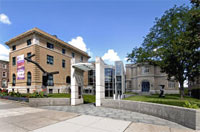
| The Four Elements of Leigh Li-Yun Wen Through JUNE 19, 2022 The four elements of western cosmology—earth, air, fire, water—are the subjects of artist Leigh Li-Yun Wen’s work. Whether paintings, prints, or ceramics, Wen’s art expresses her personal and cultural histories. Having grown up on the island of Taiwan, she possesses a deep affinity for the elemental power of water and the forces of nature. As a Taiwanese-American artist who has lived in both Taiwan and America, she feels the ebb and flow of competing cultures. The ancient philosophies of her homeland, which teach self-discipline and selflessness, collide and mingle with Western notions of ego, alienation, and desire. Wen’s working method is a process of subtraction from darkness to light. “I carve into the paint with a stylus to bring forth the individual lines that are the central motif of my work,” she notes. These lines flow across the canvas in rhythms and frequencies that create depths and swells on the painted surface. Something of the self is lost in the resulting tangle and then regained, only to be lost again. Simplicity and harmony exist within the chaos of the world. Color is used to expand the emotional range in Wen’s work: “my palette is drawn not from appearances but from the lyric and psychic necessities of my art.” The uniformity of line, from edge to edge and painting to painting, implies suppression of the artist’s hand in favor of objectivity learned from nature. In spite of this, her work remains deeply autobiographical. Born in Taipei, Taiwan, Leigh Li-Yun Wen is a Taiwanese-American artist who resides in New York City. She received her MFA from the State University of New York at Albany in 1994 and served as a cultural ambassador envoy during the Clinton, Bush, Obama, Trump, and Biden administrations. She has exhibited in eighteen American embassies, consulates, and other government institutions located in countries such as Jordan, Malaysia, Singapore, Namibia, Botswana, Philippines, Hong Kong, Taiwan, Denmark, and Poland. Wen was awarded a 1997 New York Foundation for the Arts Fellowship and was honored to be the Artist of New York State by the New York State Legislature. In 2000, she was again awarded a New York Foundation for the Arts Fellowship and The Helena Rubinstein Fellowship. In 2001, She won the Lorenzo de Medici Award at the Florence Biennale. In addition, Wen was awarded Artist Grants by the Pollock-Krasner Foundation in 1999 and 2005 and was invited by then-First Lady Laura Bush and Secretary of State Colin Powell to visit the White House in 2005. A frequent nominee to a select list of sixty U.S. artists invited to the White House’s annual arts and culture reception, Wen is an artist held in high esteem not only across the U.S. but also internationally, in curatorial and collectors' circles, for her achievements and the unique character of her work. Wen’s works are held in many private and public museum collections, in the permanent collection of the United States Embassy in Barbados, and the American Institute in Taiwan. This exhibition is presented by the Taipei Cultural Center in New York, Ministry of Culture, Republic of China (Taiwan). Leading support has been provided by Omni Development Company, Inc., the Taiwanese American Cultural Society of the Capital District, the University at Albany Foundation, Dorice Brickman, Mr. Alan P. Goldberg, William M. Harris and Holly A. Katz, Vicary and Peter Thomas, and Mr. Daniel L. Wulff. Major support is provided by Eleanor Holbritter Nasner and Margaret F. Holbritter, Mr. Edward Swyer, and Chester and Karen Opalka. Season exhibition and program support is provided by Phoebe Powell Bender, Mr. and Mrs. George R. Hearst III, Charles M. Liddle III, Lois and David Swawite, the Carl E. Touhey Foundation, Inc., and Candace K. Weir. |
|||||||||||
|
|||||||||||
| Support Your Local Galleries and Museums! They Are Economic Engines for Your Community.
Subscribe to Our Free Weekly Email Newsletter! |
|||||||||||
| ADVERTISE ON THIS SITE | HOME | EXHIBITIONS | INDEX | ABOUT US | LINKS | CONTACT US | DONATE | SUBSCRIBE |
| Copyright 2023 Art Museum Touring.com |