HOME INDEX EXHIBITIONS EVENTS ABOUT US BLOG LINKS CONTACT US SUBSCRIBE

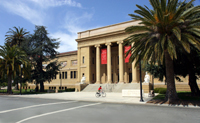
Cantor Arts Center at Stanford University

Iris & B. Gerald Cantor

Center for Visual Arts

at Stanford University


Stanford, CA

SUPPORT OUR ADVERTISERS. THEY MAKE THIS SITE POSSIBLE
Premium Ad Space

Iris & B. Gerald Cantor Center for Visual Arts
(Cantor Arts Center at Stanford University)

328 Lomita Drive at Museum Way
Stanford, CA 94305-5060
Telephone 650-723-4177
Fax 650-725-0464

Map


http://museum.stanford.edu/index.html

Exhibitions:

Wood, Metal, Paint: Sculpture from the Fisher Collection

Memory and Markets: Pueblo Painting in the Early 20th Century

Expanding Views of Africa

Sequence, sculpture by distinguished American contemporary artist Richard Serra

Extreme Makeover: A Fresh Look at the Cantor Arts Center's Contemporary Collection

Collection Highlights from Europe 1500–1800, Ancient Greece and Rome

Go Figure!


Events


Central Nigeria Unmasked: Arts of the Benue River Valley
May 16–October 14, 2012

“Central Nigeria Unmasked: Arts of the Benue River Valley” opens May 16 at the Cantor Arts Center, Stanford University. Presenting more than 150 objects drawn from international collections, the exhibition gives a comprehensive view of the arts from along the river that flows across the center of Nigeria, joining the great Niger River on its way to the Atlantic Ocean. “Central Nigeria Unmasked,” on view through October 14, 2012, reveals arts and cultures of diverse peoples who are far less known and studied than those of the majority populations in the country’s northern and southern regions.

Organized in sections that unfold as a journey up the 650-mile-long Benue River, the exhibition presents artistic forms and styles associated with more than 25 ethnic groups. The objects on view embody meanings and purposes crucial to Benue Valley peoples as they confront and resolve life challenges and rites of passage such as birth, initiation, marriage, illness and death. Works include maternal figures, sleek statues, anthropomorphized vessels, elaborate regalia, masks with naturalistic human faces, and masks that appear as stylized animal-human fusions. Film footage of dynamic, complex masquerades; maps; photomurals; and written material provide further context for understanding the artworks.

“Central Nigeria Unmasked: Arts of the Benue River Valley” is organized by the Fowler Museum at UCLA in association with the Musée du quai Branly, Paris. The exhibition is co-curated by Marla C. Berns (Shirley and Ralph Shapiro Director, Fowler Museum), Richard Fardon (Professor of West African Anthropology, School of Oriental and African Studies, University of London), Sidney Kasfir (Professor of Art History, Emory University, Atlanta) and Hélène Joubert (Curator of African Collections, Musée du quai Branly) with Gassia Armenian (Curatorial and Research Associate, Fowler Museum). Major support for the exhibition is provided by the National Endowment for the Arts, the Shirley and Ralph Shapiro Director’s Discretionary Fund, Jay and Deborah Last, Ceil and Michael Pulitzer, Joseph and Barbara Goldenberg, Robert T. Wall Family and Jill and Barry Kitnick. Major funding for the publication is provided by the Ahmanson Foundation with additional support from the Ethnic Arts Council of Los Angeles. The planning phase of the project was funded by a grant from the National Endowment for the Humanities.

Central Nigeria Unmasked: Arts of the Benue River Valley is organized by the Fowler Museum at UCLA in association with the Musée du quai Branly, Paris.The exhibition's presentation is made possible at Stanford by the Center's Clumeck Fund and Cantor Arts Center Members.

Berns speaks about the exhibition on Wednesday, May 16 at 6 pm. On Thursday, May 17, New York Times art critic Holland Cotter presents the Wilsey Distinguished Lecture, entitled “Critical Consciousness: Art and the World,” at 6 pm in Annenberg Auditorium, Cummings Art Building. A Nollywood Film Festival is being presented Saturday, June 9, from 11 am to mid-afternoon. Docents offer tours of the exhibition on Thursdays at 12:15 pm and Saturdays and Sundays at 2 pm. The programs are free, and all except the May 17 lecture are at the Cantor Arts Center.

Wood, Metal, Paint: Sculpture from the Fisher Collection
February 29, 2012–October 13, 2013

A new installation of contemporary art, “Wood, Metal, Paint: Sculpture from the Fisher Collection,” in the Oshman Family Rotunda. The works will remain on view until fall 2013.

Over the last decade the Fisher Family has been exceedingly generous in lending works of art from their unrivalled collection to the Cantor Arts Center. Richard Serra’s Sequence is the most recent loan from a roster of artists that has included Ellsworth Kelly, Agnes Martin, Isamu Noguchi and Andy Warhol, as well as other famous contemporary masters.

“Wood, Metal, Paint: Sculpture from the Fisher Collection” includes pieces by John Chamberlain, Sol LeWitt Claes Oldenburg and Martin Puryear, together with Carl Andre’s Copper-Zinc Plain, a floor piece comprised of 36 tiles, and John Chamberlain’s Bijou, a large early work made of crushed automobiles and paint. The works on display are especially significant because they are examples of the innovations that established the reputations of these artists. Hilarie Faberman, the Center’s curator of modern and contemporary art, selected works for this long-term installation in consultation with Pamela Lee, professor of contemporary art at Stanford, who will use the exhibition in teaching about sculpture from the 1960s to the 1980s.

This exhibition is made possible by support from the Cantor Arts Center’s Contemporary Collectors Circle.


Memory and Markets: Pueblo Painting in the Early 20th Century
Exhibition Spotlights a Unique Development in Native American Art History with Works from Three Collections
February 22 – May 27, 2012

A new movement of Native American painting emerged in the Pueblo communities of the southwestern United States in the early 20th century. Encouraged by anthropologists and teachers to record past and current scenes of their daily life on paper, the artists found inspiration in the centuries-old tradition of Pueblo painting seen in pottery, murals and archaeological remains.

The earliest Pueblo artists were self-taught, and they struggled for recognition from the local and national art market. In the 1930s, the formation of the Studio at the Santa Fe Indian School formalized the training of generations of Native painters and secured the continuance and expansion of this new tradition of Native American easel painting. The resulting works were dynamic, colorful and decidedly modern.

“Memory and Markets: Pueblo Painting in the Early 20th Century,” at the Cantor Arts Center from February 22 through May 27, outlines the history of this development. This exhibition includes works by well-known artists such as Tonita Peña (Quah Ah) and Alfonso Roybal (Awa Tsireh), both from the San Ildefonso Pueblo. Recent gifts from the collection of Malcolm and Karen Whyte and four important loans from the California Academy of Sciences in San Francisco, including a painting by Allan Houser, augment highlights from the Center’s collection. “Memory and Markets” presents nearly 20 paintings in the Lynn Krywick Gibbons Gallery plus a small selection of pottery exemplifying early painting traditions.

The exhibition coincides with Stanford’s 41st annual Powwow, hosted Mother’s Day weekend, May 11–13, 2012, by the Stanford American Indian Organization. Learn more about Powwow details.

The exhibition is made possible by the Lynn Krywick Gibbons Exhibitions Fund.


Expanding Views of Africa
Ongoing

Works from 5000 Years of African Art, Culture, and Beliefs on View in the Enhanced Galleries for African Art

Stanford, California — Cantor Arts Center at Stanford University announces "Expanding Views of Africa," opening August 3, 2011. This enlarged and enhanced reinstallation, which includes 200 works from the collection and key loans, broadens conventional views of African art, from ancient cultures before the dynasties of the Egyptian Pharaohs to contemporary artists. Admission to the Cantor Arts Center and to the exhibition is free.

"The art of Africa dates from the beginning of humanity to the present, and African art expresses ideas about humanity that are held in common with peoples all over the world and throughout time," said Barbara Thompson, Ph.D., Phyllis Wattis Curator of the Arts of Africa and the Americas. "I am excited about this opportunity to introduce our visitors to a new way of considering African art and culture, in its historical depth and diversity. We are featuring a greater range of media and chronological, geographic, and thematic representation than ever before. The objects now on view illustrate the unique nature of the Cantor Arts Center's African collection and demonstrate our new strategies in collection development and display."

Before entering the African galleries, a niche off the lobby highlights a single object: a full-sized bush buffalo costume with mask from the Nunuma culture of Burkina Faso. Once in the first gallery, visitors encounter contemporary works made in a variety of media from the 1950s to the present, by artists living in Africa and the Diaspora. The next space presents African arts from the 16th to the mid-20th century. The final gallery features the oldest African arts in museum collections, ranging from pre-dynastic Egypt to 15th-century sub-Saharan cultures. The earliest antiquities on view, pottery from approximately 4000–3100 BCE, predate the emergence of a single powerful leader and the unification of Egypt under the Pharaohs.

Thompson uses a thematic approach to correlate objects throughout the ancient, historic, and contemporary sections of the reinstallation. The theme "Fashioning the Body/ Defining the Self" includes body adornment used to define gender, cultural affinity, age, and social status, such as contemporary Tuareg jewelry, 19th-century Nguni beadwork, and an ancient Egyptian necklace. "Economies and Exchanges in Africa and Beyond" is exemplified by ancient Egyptian trade objects, goldweights from the historic period, and a contemporary abstracted painting of a busy market. "Moments of Transformation" includes an Egyptian mummy mask, from the 7th–6th century BCE, which aids in transitioning to the afterlife, and a 19th-century bocio figure used in the Vodoun religion of the Fon peoples of the Republic of Benin. Bocio figures help to bring about protection, wellbeing, wisdom, and balance. The Vodoun religion spread throughout West Africa and to the Americas with the trans-Atlantic slave trade, a troubled history that Beninese artist Gérard Quenum recalls in his "Night Watchman," a sculpture from 2004 that promotes thought and social commentary.


Sequence, sculpture by distinguished American contemporary artist Richard Serra
Through 2016

The sculpture “Sequence” by distinguished American contemporary artist Richard Serra installed at the Cantor Arts Center at Stanford University as a loan from the Doris and Don Fisher Collection. The work will remain on view at Stanford until it is presented as part of the inaugural installation of the Fisher Collection in the expanded San Francisco Museum of Modern Art, in 2016.

“Sequence,” which measures 67 feet long, 42 feet wide, and 13 feet high, is composed of contoured steel and weighs more than 200 tons. Considered one of Serra’s greatest achievements, the work will be on view outdoors for the first time since its creation in 2006. “Sequence” was previously shown in the exhibition “Richard Serra Sculpture: Forty Years” at the Museum of Modern Art, New York, in 2007, and subsequently at the Los Angeles County Museum of Art from 2008 to 2011. Transporting it from Los Angeles to Stanford requires a dozen wide-body flatbed trucks and specialists in the rigging of objects on this massive scale. The work of sculptor Richard Serra (born 1939) challenges the divide between architecture and sculpture and requires the participation of the viewer to engage its extraordinary spaces. “Sequence” is composed of two interlocking figure eights, which will be installed on the Cantor Arts Center’s north grounds by late July. The viewer enters through one of the work’s two openings and can wander through inner and outer steel plates. The
curvilinear walls slant, creating a vertiginous and disorienting experience for the visitor who traverses the interior. The second floor of the Cantor Arts Center provides an overview of the installation’s progress and then of the work itself.

“Sequence” augments a distinguished collection of sculpture on the Stanford University campus, including 40 modern and contemporary works by Josef Albers, Alexander Calder, Mark di Suvero, Charles Ginniver, Andy Goldsworthy, Jacques Lipschitz, Joan Miró, Henry Moore, Beverly Pepper, George Segal, and a score of other artists. In addition, 20 works grace the Rodin Sculpture Garden on the south side of the Cantor Arts Center, and Rodin’s famous “Burghers of Calais” are in Memorial Court, at the entrance to the Main Quad. The Papua New Guinea Sculpture Garden presents another 40 works in stone and wood, carved in 1994 by 10
visiting Kwoma and Iatmul artists from the Sepik River area of northern New Guinea. To experience “Sequence,” visitors must enter the Cantor Arts Center to gain access to the north grounds. The Cantor Arts Center is open, free of charge, Wednesday through Sunday from 11 am to 5 pm, with extended hours on Thursday until 8 pm. Other outdoor sculpture on campus is available for viewing at all hours. An additional exhibition focusing on books this season is “The Art of the Book in California: Five Contemporary Presses,” on view at the Cantor Arts Center June 1 – August 28, featuring works that exemplify the book arts in California today.


Extreme Makeover: A Fresh Look at the Cantor Arts Center's Contemporary Collection
Ongoing

This reinstallation of the contemporary gallery juxtaposes new acquisitions with familiar pieces and works that have been off view. Anchoring the display are works by Bay Area figurative and abstract expressionist sculptors and painters based in California, such as Manuel Neri, Jeremy Anderson, John Cederquist, Alvin Light, James Weeks, and Frank Lobdell. Modern and contemporary pieces acquired in the last decade are carefully selected for the varied groupings in this display and include works by Robert Arneson, Isamu Noguchi, Elmer Bischoff, Joan Brown, and Al Held. The prominent south wall features vibrant color field paintings by artists such as Jules Olitski, Frank Stella, and Miriam Schapiro.


Collection Highlights from Europe 1500–1800, Ancient Greece and Rome
Ongoing

Cantor Arts Center at Stanford University announces the opening on May 5, 2010 of “Collection Highlights from Europe 1500-1800, Ancient Greece and Rome,” which continues indefinitely. The museum’s second-floor gallery devoted to European art is revitalized and now includes artworks from the ancient Mediterranean, in addition to 16th- through 18th-century art from western Europe. Divided into six sections, the gallery presents highlights from the collection as well as significant loans from private collections. Admission to the museum and the exhibition is free.

Visitors can again see important works from the Center’s collection of Greek, Roman, and Cypriote artifacts, which have been off view since February 2009. This new display of ancient art offers students and the public a wide variety of objects to study and enjoy, including portrait reliefs from Palmyra, clusters of red- and black-figure Grecian vases, marble torsos from Rome, as well as diverse Cypriote vessels.

The other five sections in the gallery are devoted to European paintings, sculpture, and works on paper dating from about 1500 to 1800. Portraits by Joseph Wright of Derby and Thomas Gainsborough and Gavin Hamilton’s neoclassical “Hebe” are featured with other paintings from Great Britain. Abraham van Beyeren’s “Still Life with Crab” and “The Sacrifice of Jeroboam” by the pre-Rembrandt master Claes Moeyaert are among the paintings included in the area devoted to the Lowlands. The Italian paintings include “Virgin and Child with St. John” by Jacopo Sellaio, Francesco Trevesani’s poignant “Dead Christ,” and the mysterious “Sorceress” by Bartolomeo Guidobono. In addition four eccentric, allegorical portraits from the circle of the Milanese artist Giuseppe Arcimboldo are on loan from the collection of Kirk Edward Long. The French section features Jean Vignon’s portrayal of the “Lament of St. Peter” and a recent acquisition, François-André Vincent’s depiction of “Zeuxis Choosing His Models.” In addition, the Thoma family is lending three more paintings from colonial South America to join the Cuzco school “Last Judgment” already on loan to the museum.

The final section of the gallery is devoted to the Center’s important collection of works on paper. “Because of their sensitivity to light, these works cannot remain on view for very long,” explained Bernard Barryte, the Center’s curator of European art, “so this space will enable the staff to organize small, focused displays that will change twice a year." Celebrating the new installation of classical antiquities, the first rotation of works on paper examines the European fascination with ruins.

The gallery's installation is supported by Cantor Arts Center Members.


Go Figure!
September 1 - August 5, 2012

The Cantor Arts Center at Stanford University announces new displays of contemporary art. When the art museum at Stanford reopened in 1999 as the Cantor Arts Center, the top floor of its new wing was devoted to art of the past four decades. Since then, more than 750 works of European and American art in diverse media have been added to the modern and contemporary collection, expanding it to 2700 objects and extending it into the 21st century. Selections from this enhanced collection open in four galleries.

“Go Figure!” begins September 1, 2010. Although recent art is often equated with abstraction, many important artists of the last 50 years have explored the human figure in their paintings and three-dimensional work. “Go Figure” includes 25 figurative paintings and sculpture, including witty examples by Karel Appel, Richard Shaw, Richard Stankiewicz, Viola Frey, and Roger Brown; politically charged works by Robert Arneson and Terry Allen; and traditional approaches to the human form by Robert Graham and Martin Blank. This overview includes works from each decade since the 1950s, presented in three adjacent spaces: the Oshman Family Rotunda, the H. L. Kwee Galleria, and the McMurtry Family Terrace.


Collections

  • Europe & America
  • Modern & Contemporary
  • Works on Paper: Prints, Drawings, and Photographs
  • Asia
  • Africa
  • Oceania
  • Native Americas
  • Stanford Family Collection


Calendar

Support Your Local Galleries and Museums! They Are Economic Engines for Your Community.

Subscribe to Our Free Weekly Email Newsletter!

Advertise with this banner
BACK NEXT
Copyright 2012 Art Museum Touring.com