 |
||||||||||||||||
|
||||||||||||||||
|
||||||||||||||||
| SUPPORT OUR ADVERTISERS. THEY MAKE THIS SITE POSSIBLE |
| Premium Ad Space |
Dallas Museum of Art
1717 N. Harwood St.
Dallas, TX 75201
(214) 922-1200
Map
www.dallasmuseumofart.org
Exhibitions
When You See Me: Visibility in Contemporary Art/History
From Munch to Kirchner: The Heins Collection of Modern and Expressionist Art
Artists Interject: The Impressionist Revolution from Monet to Matiss
Love Island: Japanese Weddings of the Edo Period
Not Visible to the Naked Eye: Inside a Senufo Helmet Mask
Backs in Fashion: Mangbetu Women’s EgbeAug 3rd, 2025
August 18 to November 17, 2024
Explore the life of Frida Kahlo, one of the 20th century's most well-documented and enigmatic artists, and an architect of her own persona. Meet Frida as she saw herself . . .
Taking a chronological approach, this exhibition will lift the veil of myth surrounding Kahlo by delving deeper into the defining moments of her life and how she embedded symbolic motifs in her self-portraits and still lifes to cryptically express her emotive reactions to major events. These works will be supplemented with photographs of Kahlo taken by the friends and fellow artists who knew her best, capturing the vulnerability and sensuality that still compel us today.
This August, the DMA presents Frida: Beyond the Myth. Composed of 60 works across media—paintings, drawings, prints, and photographs—the exhibition will explore the life of one of the 20th century’s most well-documented artists, who continues to elude our understanding of her as an individual.
August 18-November 17, 2024
Barrel Vault
Explore the complexities of visibility in our latest exhibition, When You See Me: Visibility in Contemporary Art/History. The exhibition aims to broaden and complicate official histories and their corresponding visual strategies to allow for richer representations of those who have been traditionally excluded or erased. When You See Me features nearly 60 works by a diverse, intergenerational group of 50 artists who contend with visibility both socially and formally. Their works explore invisibility, hypervisibility, the desire to be seen, and the right to be private.
The multivocal nature of this show is reflected in its co-curation by the Museum’s entire Contemporary Art Department, which comprises Dr. Anna Katherine Brodbeck, Dr. Vivian Li, Ade Omotosho, and Veronica Myers.
Artists in the Exhibition: Pacita Abad | Michael Armitage | Hernan Bas | Kevin Beasley | Mark Bradford | Garrett Bradley | Willie Cole | Anthony Cudahy | Kyle Dunn | David Drake | Lizzie Fitch | Theaster Gates | Jameson Green | Jenna Gribbon | Chase Hall | David Hammons | Sky Hopinka | Peter Hujar | Rashid Johnson | Samuel Levi Jones | Rachel Jones | Shigeko Kubota | Yowshien Kuo | Simone Leigh | Marisol | Wangari Mathenge | Senga Nengudi | Ren Light Pan | Anna Park | Pope.L | Puppies Puppies (Jade Guanaro Kuriki-Olivo) | Noah Purifoy | Christina Quarles | Marc Quinn | Gerhard Richter | Deborah Roberts | Ilana Savdie | Tschabalala Self | Tavares Strachan | Krzysztof Strzelecki | Salman Toor | Ryan Trecartin | Danh Vo | Nari Ward | Susan Weil | Charles White | David Wojnarowicz | Carrie Yamaoka | Michaela Yearwood-Dan
When You See Me: Visibility in Contemporary Art/History is organized by the Dallas Museum of Art. Free General Admission to the Dallas Museum of Art is funded, in part, by the Robert Gerard Pollock Foundation. Additional support for the Museum is provided by generous DMA Members and donors, the Texas Commission on the Arts, and the citizens of Dallas through the City of Dallas Office of Arts and Culture.
Through Jan 5, 2025
Location Level 2
From Munch to Kirchner: The Heins Collection of Modern and Expressionist Art celebrates the legacy of Marie “Elinor” Heins through the recent gift of 30 paintings, sculptures, and works on paper from her heirs. Between 1967 and her death in 2018, Heins amassed an impressive collection of modern artwork that she displayed in her home in Montreux, Switzerland.
The Heins collection is divided evenly between late 19th- and early 20th-century art movements: Impressionism, Post-Impressionism, and German Expressionism, Heins’s favorite. Highlights include works by Pierre-Auguste Renoir, Paul Signac, Henri Toulouse-Lautrec, and Edvard Munch—artists who depicted contemporary subjects in an equally contemporary style.
“Being in the presence of art which I like and which touches me gives me enormous aesthetic pleasure.” —Elinor Heins
From Munch to Kirchner: The Heins Collection of Modern and Expressionist Art is organized by the Dallas Museum of Art. Free General Admission to the Dallas Museum of Art is funded, in part, by the Robert Gerard Pollock Foundation. Additional support for the Museum is provided by generous DMA Members and donors, the Texas Commission on the Arts, and the citizens of Dallas through the City of Dallas Office of Arts and Culture.
Through Nov. 3, 2024
he Impressionist Revolution from Monet to Matisse explores the fascinating story of Impressionism from its birth in 1874 to its legacy in the early 20th century. Told almost entirely through the DMA’s exceptional holdings, this exhibition reveals the rebellious origins of the independent artist collective known as the Impressionists and the revolutionary course they charted for modern art.
Breaking with tradition in both how and what they painted, as well as how they showed their work, the Impressionists redefined what constituted cutting-edge contemporary art. The unique innovations of its core members, such as Claude Monet, Edgar Degas, and Berthe Morisot, set the foundation against which following generations of avant-garde artists reacted, from Paul Gauguin and Vincent van Gogh to Piet Mondrian and Henri Matisse.
Celebrating the 150th anniversary of the first Impressionist exhibition, The Impressionist Revolution invites you to reconsider these now beloved artists as the scandalous renegades they were, as well as the considerable impact they had on 20th-century art.
Through the Lens
Nicole R. Myers is Chief Curatorial and Research Officer and The Barbara Thomas Lemmon Senior Curator of European Art. Since joining the DMA in 2016, she has curated/co-curated numerous exhibitions, including Van Gogh and the Olive Groves (2021–2022); Cubism in Color: The Still Lifes of Juan Gris (2021); and Berthe Morisot, Woman Impressionist (2018–2019). Myers previously held curatorial positions at The Nelson-Atkins Museum of Art, The Metropolitan Museum of Art, the Museum of Fine Arts, Boston, and Saint Louis Art Museum. She completed her MA and PhD in Art History at the Institute of Fine Arts of New York University.
Through Oct 6th, 2024
Level 3
Love Island: Japanese Weddings of the Edo Period explores the exquisite artistry and craftsmanship of some of the important elements of an Edo period bridal trousseau and touches on the strategic alliances that were created between Edo Japan’s Tokugawa shogunate and daimyo (provincial feudal lords) through matrimony. This installation features a selection of elegant and luxurious bridal objects on loan from the Museum of Fine Arts, Houston, including a black and gold lacquer toilette set that once belonged to a member of the Tokugawa ruling clan, an incense guessing game set, and a lavish wedding kimono.
Love Island: Japanese Weddings of the Edo Period is organized by the Dallas Museum of Art. Free General Admission to the Dallas Museum of Art is funded, in part, by the Robert Gerard Pollock Foundation. Additional support for the Museum is provided by generous DMA Members and donors, the Texas Commission on the Arts, and the citizens of Dallas through the City of Dallas Office of Arts and Culture.
Through Feb 1st, 2026
Conservation Gallery
The DMA’s Conservation and Arts of Africa departments, in an exciting and cutting-edge collaboration with UT Southwestern Medical Center, will present CT scans of a Senufo helmet mask from the Museum’s African art collection. This kind of mask is worn like a helmet by a medium at initiations, funerals, harvest celebrations and secret events conducted by the powerful male-only Komo society, which has traditionally maintained social and spiritual harmony in Senufo villages in Côte d’Ivoire, Mali, and Burkina Faso. Visible attachments on the mask include a female figure, cowrie shells, and imported glassware. The CT-scans reveal unexpected materials beneath the surface and objects contained in the attached animal horns that empower the mask.
Dr. Matthew A. Lewis and Dr. Todd Soesbe, faculty members of the Department of Radiology at the Medical School of The University of Texas Southwestern Medical Center, assisted with this exhibition.
Through Aug 3rd, 2025
Level 3
On view in the African Art galleries, Backs in Fashion: Mangbetu Women’s Egbe explores the art of the egbe, a back apron garment created by upper-class Mangbetu women. This exhibition investigates the artistic process, essential function, and cultural role that egbe garments played in Mangbetu society.
Through Aug 3rd, 2025
Concourse
The sixth iteration of the Museum’s Concourse mural series will feature an installation by artist Tiffany Chung, who is internationally known for her diverse conceptual work and research-driven process dealing with sociopolitical issues. Contending with issues of conflict, geopolitical partitioning, spatial transformation, environmental crisis, and forced migration in relation to history and cultural memory, Chung’s practice endeavors to document and discuss the micro, hidden histories—the memory and experiences of ordinary people—that counterbalance the grand narratives produced by the state.
Her commissioned mural centers narratives of migration and movement, especially those found within Dallas, in recognition and celebration of these lived experiences. This multisensorial and immersive installation seeks to engage guests with poetic, sonic, and visual possibilities in sharing the stories that people carry with them.
Rise Into the Atmosphere was a collaboration between Tiffany Chung and 28 international participants:
Omran Adrah, Jose Antonio Agüero, Ahmad Aljarrah, Julianna Banks, Drishti Bathija, Nipun Bhatnagar, Isaac Hernández Campos, Jose Rodrigo Contreras, Sara Fakhry, Sebastián Izaciga, Robbie Koeck, Nelleke Kuipers, Yuna Lee, Meiling Liu, Ankita Mathew, Yousseff Moustafa, Mario Norton, Alliyah Qualls, Renz Ren, Randy Reynolds, Pablo Schuller, Nimrod Schwartz, Aviram Spies, Shankara Srikantan, Manos Stratis, Tala Sukkar, Edwin Toh, and Lucas Zapiola.
Admission is free.
Tiffany Chung: Rise Into the Atmosphere is organized by the Dallas Museum of Art. The Dallas Museum of Art is supported, in part, by the generosity of DMA Members and donors, the National Endowment for the Arts, the Texas Commission on the Arts, and the citizens of Dallas through the City of Dallas Office of Arts and Culture.
Through Dec. 29, 2024
Mezzanine 2
Dallas Museum of Art Selects Nieto Sobejano Arquitectos as Winner of International Design Competition
Winner’s concept design proposes a radical transformation to speak to new audiences and improve accessibility while sustainably preserving much of the original Edward Larrabee Barnes building
Nieto Sobejano Arquitectos described their competition-winning proposal—which will be developed by the Museum in consultation with its stakeholders and communities—“as a reflection of the original building, transforming the relationship between art, landscape, and community into a balance of memory and innovation.”
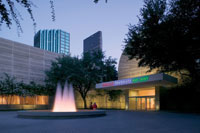
While respecting Edward Larrabee Barnes’s original design intent in his 1984 building, the NSA proposal includes a new floating contemporary art gallery on the roof and rebalances the north and south façades, communicating the expression of art via an exterior LED-generated artwork mediated by a perforated surface. Transparent glazing at the north façade (Klyde Warren Park) and at the Harwood Street façades at ground level gives passers-by views of visitors inside the Museum engaging with the art.
Throughout the competition process, the Museum has been focused on its vision as originally set out in its 2021 Five Year Strategic Plan: to better serve the diverse city of Dallas and be a dynamic connector where people of all cultures feel welcomed and embraced.
“Bravo Nieto Sobejano! We are thrilled to welcome you and introduce you to our outstanding collection as well as our communities, Board of Trustees, and staff,” said, Dr. Agustín Arteaga, the DMA’s Eugene McDermott Director.
“We were delighted to share our journey through the competition process with our communities, and we thank them for their feedback and positivity. We will continue working with them and with Nieto Sobejano to make this project happen, to serve Dallasites and newcomers, and people of all cultures, ethnicities, and beliefs.”
The winner’s concept design is available to view in a free presentation on Mezzanine Level 2 (M2) at the DMA through this fall. Learn more at Reimagining the Dallas Museum of Art International Design Competition (malcolmreading.com).
Through December 31, 2026
Focus Gallery
The Keir Collection of Islamic Art Gallery is the largest public presentation in the history of one of the world's most important private collections of Islamic Art. The gallery will highlight particular strengths within the collection, which encompasses one of the most important holdings of luster pottery and rock crystals in the world including the celebrated rock crystal ewer, one of only seven in the world of its caliber and the only one of its type in the United States. The gallery space will display a series of rare manuscripts and painted miniatures of exquisite beauty, including a 16th-century Indian Khamsa of Nizami manuscript, and pages from the 1330 Shahnama known as “The Demotte Shahnama.”
The Keir Collection came to the DMA on a long-term loan agreement with the trustees of the Keir Collection that was finalized in 2014, transforming the Museum into the third largest repository of Islamic art in the United States.
|
|
||
|
Support Your Local Galleries and Museums! They Are Economic Engines for Your Community.
Subscribe to Our Free Weekly Email Newsletter! |