|
|
|||||||||||
|
||||||||||||
![]() |
|
|||||||||||
|
![]() |
|||||||||||
![]() |
|
|||||||||||
|
![]() |
|||||||||||
![]() |
|
|||||||||||
|
The Old Jail Art Center www.theoldjailartcenter.org Hours: Mission Statement: Permanent Exhibitions:
Face Time: Portraits from the Collection Asian Art: Selections from the Permanent Collection
Face Time is drawn from the diverse holdings of the OJAC and presents portraits in a variety of styles and media from painting and drawing to prints and sculpture. Over all, the exhibition adheres to the classic or technical definition of a portrait as capturing the likeness of a person, especially the face. However, within the context of this show we have included a number of works where the subject's face is not the primary focus, but assumes a secondary role, or is implicit in the artist's title of the work. Still, other portraits capture the essence of the subject as interpreted by the artist through gesture or abstract elements while being void of recognizable facial features. Hence, portraiture in the broadest sense, particularly in works with modernist tendencies, is an "anything goes" genre where the intent of the artist is the overarching determiner as to whether the work is considered a portrait. The art selected for this first-time portrait survey, demonstrates the depth and breadth of the Museum's portrait collection and includes work from the 17th century to the present. The artists represented are among the finest of their generations including: Rembrandt van Rijn, Amedeo Modigliani, Henri Matisse, John Sloan, Andy Warhol, Andrew Dasburg, Francoise Gilot, Bill Bomar, Wm. Kelly Fearing, Dickson Reeder, Evaline Sellors, Cornelis Ruhtenberg, and Kiki Smith, and to mention a few. Many artists are represented by multiple examples (Bill Bomar and Dickson Reeder for example) because of the volume of excellent portraits by each of these artists in our collection. Significantly, many well-known Albany citizens are represented by portraits including Reilly Nail, Alice Reynolds, Matilda Nail-Peeler, and Wyldon Burgess Nail. In organizing this exhibit, the focus was solely on American and European art because of space limitations and curatorial prerogative. Consequently, one will not see any examples from the Asian and Pre-Columbian collections. It is significant to note that a large triptych by Robert Rauschenberg titled Autobiography will be ancillary to the exhibit in a neighboring gallery. Face Time was organized by The Old Jail Art Center. The exhibition will feature a catalogue as an interpretive guide. The exhibit was made possible due to the generous sponsorship of Kate and Charles Ferguson, K. Flories Antiques, Sally M. Jones, and Nancy Green, in memory of Bob Green. -Thomas W. Jones, Executive Director
Artist Eric Zimmerman explores concepts of utopias, human endeavors, time and place, history, and multiple meanings within appropriated materials in his art. His media varies from traditional graphite drawings to complexly constructed installations. As a participant in the OJAC's Cell Series, Zimmerman will layer his selected themes in the context of the historic 1877 jail building and the Museum's archival holdings. Zimmerman has a keen interest in the American west and the "multiple ways we experience and historicize it" as well as the symbols we utilize to represent and understand it. In this complex installation, he also references concepts relating to the sublime, manifest destiny, and our longing to explore the void. Zimmerman's installation, within the confines of the upper cells of the Museum's historic 1877 old jail building, will involve a variety of media exploring his concepts. Accurately rendered, graphite drawings of appropriated imagery from magazines, books and other print media are juxtaposed with sound tracks within one of the galleries. These monochromatic facsimiles of art related subjects, magazine articles, pop media, and instructional diagrams take on different meanings when interpreted with the ever-changing sound track. Zimmerman states the sound pieces "dramatize and manipulate the ‘feeling' a space has and how that affects how you see the drawings and other works within the space." As he sometimes does, Zimmerman produces and incorporates an actual "take-away," black and white, newspaper into the installation. Tentatively titled How the West was Won, it blurs the lines between source material, gallery guide, artwork, and souvenir, as well as truth and myth. Zimmerman currently lives in Tivoli, New York and received his MFA in 2005 from the University of Texas in Austin. He has had solo shows at Art Palace and Slugfest Gallery in Austin Texas and participated in numerous group shows at Capricious Gallery, New York, NY; Fort Worth Contemporary, Fort Worth, Texas; Diverse Works, Houston, Texas; Austin Museum of Art, Austin, Texas and the Galveston Arts Center, Galveston, Texas.
In late September the Robert E. Nail Jr. Archives will produce a new exhibit which focuses on the life and work of artist Evaline Sellors. Sellors was a member of the Fort Worth Circle of artists, and was also well known for her skills and experience as an instructor. The exhibit will feature a variety of documents and materials ranging from original sketches of the bas-reliefs at Farrington Field, to unique tools Sellors used on some of her ceramic pieces, as well as a handmade stuffed dog called Tut’s Pup.
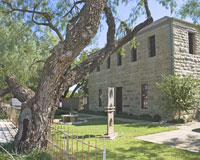
The museum's Asian Collection has been re-installed in refurbished galleries in the 1877 old jail building of the Old Jail Art Center. Patrick Kelly, OJAC Preparator, designed the reinstallation and built new exhibit cases to house the pieces. Jennifer Casler Price, Curator of Asian and Non-Western Art at the Kimbell Art Museum, researched the collection and wrote the labels and didactic material for the reinstallation. OJAC Education Director Kathryn Mitchell developed a teacher's resource guide to the Asian Collection. All this work was funded in part by a grant from the United States Institute of Museum and Library Services, a federal agency. From its earliest days, the Old Jail Art Center has had Asian art in its collection. The mothers of the museum's co-founders, Reilly Nail and Bill Bomar, collected Asian art. At the time of the museum's founding, the late Jewel Nail Bomar's collection of ancient Chinese tomb figures was in her son's hands, and he contributed it to the initial collection of the museum. Nail persuaded his mother, Wyldon Burgess Nail Harrold, to give pieces from her collection of more recent artifacts. Through the years, others have enriched the collection with their gifts, including co-founders Bomar and Nail. Though small and eclectic, the collection comprises Chinese ceramics from the Han through Qing dynasties as well as an assortment of Japanese prints and ceramics and a few works from other cultures. Pieces from the collection will be rotated through the old jail galleries. To augment the exhibition, the museum borrows Asian art from other collections-in the inaugural installation from the Trammell & Margaret Crow Collection of Asian Art, Dallas, and the Arthur M. Sackler Foundation, New York City. |
||||||||||||
|
||||||||||||
|
||||||||||||
|
||||||||||||
|
||||||||||||