HOME INDEX EXHIBITIONS EVENTS ABOUT US BLOG LINKS CONTACT US SUBSCRIBE

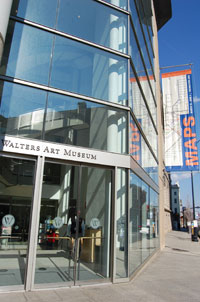
The Walters Museum
The Walters

Art Museum


Baltimore, MD

SUPPORT OUR ADVERTISERS. THEY MAKE THIS SITE POSSIBLE
Premium Ad Space
The Walters Art Museum
600 N. Charles Street
Baltimore, MD 21201
410-547-9000
Map
www.thewalters.org

Exhibitions:

Hashiguchi Goyo’s Beautiful Women

Near Paris: The Watercolors of Léon Bonvin

Exploring Art of the Ancient Americas: The John Bourne Collection Gift

Peer One Video Tour

Palace of Wonders: Renaissance & Baroque Galleries

Art of the Ancient Americas


Events


Hashiguchi Goyo’s Beautiful Women
May 19–August 12, 2012

The brief career of Hashiguchi Goyo, beloved and respected as one of Japan’s greatest shin hanga, or new woodblock print artists, occupies a crucial turning point in the history of Japanese print making. The 12 prints in this exhibition look back to Japan’s traditional woodblock printing industry while laying the foundation for the modern print tradition that would dominate Japanese print making during the 20th century.

While some 20th-century Japanese print artists followed their Western counterparts by creating prints entirely on their own, Hashiguchi Goyo adhered to Japanese tradition. He employed carvers and printers to work under his careful supervision, resulting in refined printed images of extremely high quality. Each color, line and texture visible in these prints required a separate precisely carved wooden block, and the printer had to align the printing paper onto as many as 20 separate blocks to pick up the differently colored inks in just the right locations (a process called registration). Goyo rejected many of the prints that his team produced because of slight flaws in registration, lack of color uniformity or smudging. Few artists after Goyo’s time enlisted the work of the many people necessary to produce traditional prints. Instead, they created works known as sosaku hanga, or self-made prints.

Goyo only produced 14 different prints before his untimely death in 1921. Of these, eight were images of beautiful women. All eight of these prints, two pencil drawing, two posthumously finished prints and some variant prints will be displayed to highlight the distinctly 1920s look and feel of Goyo’s art.


Near Paris: The Watercolors of Léon Bonvin
Saturday, February 25, 2012–Sunday, May 20, 2012

Highly detailed and original, Léon Bonvin’s watercolors of flowers, landscapes and moon lit scenes represent a distinctive contribution to the realist movement in mid-19th century France. Bonvin’s luminous paintings reflect the humble surroundings accessible to the artist, a self-taught innkeeper on the outskirts of Paris. Museum founder William Walters acquired an outstanding collection of Bonvin’s work following the artist’s tragic suicide in 1866.


Exploring Art of the Ancient Americas: The John Bourne Collection Gift
February 12–May 20, 2012

Exploring Art of the Ancient Americas: The John Bourne Collection Gift an exhibition of 135 artworks from cultures that rose and fell in Mexico, Central America and Andean South America from 1200 B.C.–A.D. 1530. Drawn from the collection of John Bourne recently gifted to the Walters, this exhibition expresses each culture’s distinctive aesthetics, worldview and spiritual ideologies.

Modern historians group the many ancient societies south of the United States into three great traditions based on ancient geo-politics and patterns of shared cultural features: Mesoamerica, Central America and Andean South America. The exhibition features artworks as illustrations of the societies’ fundamental principles such as the shamanic foundation of rulership in Mesoamerica, Costa Rica and Panama, and the cosmic principles embodied by gold and silver in Colombia, Ecuador and Peru. Artists expressed each society’s uniqueness in novel forms of monumental and portable art of human figures, spiritual beings and deities, and companions of daily life such as dogs, made from stone, clay, precious metals and fibers.

Exploring Art of the Ancient Americas touches on the performative nature of politics and religion—performance being a key mechanism for strengthening bonds of community and religious belief. The exhibition features the imaginative musical instruments used during these events and emotive portrayals of performers—from kings to commoners.

“Before mass communication such as television, the internet or smart phones, performance was a vital public device for real-time communication of a culture’s social, political and ideological beliefs,” said Curatorial Consultant for Art of the Ancient Americas Dorie Reents-Budet. “In the ancient Americas, as elsewhere in world history, performance communicates group identity and reinforces social hierarchy, political power and other key characteristics of a society.

This exhibition features selections from collector John Bourne, who was among the initial explorers to probe deep into the hilly jungles of southern Mexico. Traveling with adventurer Carlos (Herman Charles) Frey and photographer Giles Healy, they were among the first Westerners to visit Bonampak, the now famous Maya site celebrated for its three-roomed royal building whose interior walls are covered with murals recording a battle and public rituals concerning royal political history at the site during the eighth century. Bourne became enamored of the creative expressiveness of the Maya—and of all peoples of the ancient Americas—perceiving the works as equal to any artistic tradition in the world.

“Without question, this gift from John Bourne marks a great milestone in the Walters’ 70-year history,” said Director Gary Vikan. “In the decades to come, the museum will be at the national forefront in exploring and sharing with the public the rich cultural history of the great ancient civilizations of the Western Hemisphere.”

This exhibition has been made possible through the generous contributions of John Bourne, the Women’s Committee of the Walters Art Museum, the Selz Foundation and the Ziff Family, through its endowed exhibition fund for the arts of the ancient Americas.

Highlighted artworks include:

  • Mother and Child
    (100 B.C.–A.D. 200) These cream-slipped figures were created during the culmination of the shaft tomb tradition in West Mexico, when tombs were filled with figural sculptures and pottery vessels. This woman proudly supports her son standing upon her lap, the sculpture being an informal yet stately expression of the procreative power of women and their lifelong calling as nurturers.
  • Human Effigy Pendant
    (A.D. 400–1500) The medium of choice after A.D. 500, this cast-gold alloy piece portrays a dancing musician, his performance indicated by his bent knees. This finely cast pendant may render a shaman’s spiritual transformation, signified by the serpents emanating from the top of his head.
  • Llama Effigy
    (A.D. 1000–1470) Well-adapted to the extremes of the Andean environment, the llama was at the heart of every Andean home, providing fine wool for warm clothing and being the only beast of burden in the Andes. This engaging earthenware sculpture captures the young animal’s natural inquisitiveness, its white and black face coloration following the Andean principle of duality and balance.

The exhibition will travel to the Albuquerque Museum of Art & History in New Mexico June 10–August 26, 2012 and to the Frist Center for the Visual Arts in Nashville March 3–June 23, 2013.

Publication
An illustrated catalogue of the collection, including detailed entries on objects in the exhibition, as well as a checklist of non-exhibited objects in the Bourne Collection gift, accompanies the exhibition. Written by Reents-Budet, the publication includes technical notes on many of the objects as well as an essay by Walters Senior Objects Conservator Julie Lauffenburger on the authentication of art of the ancient Americas. The publication also profits from contributions by Walters Assistant Conservator for the Ancient Americas exhibition Jessica Arista, Walters Conservation Scientist Glenn Gates and Visiting Assistant Professor of Anthropology at Tulane University and Maya epigrapher Marc Zender. Published in association with D Giles Limited, London, the hard cover edition is $65; the soft cover is $39.95.

Special Exhibition Admission Prices:
$10 Adults
$8 Seniors
$6 Students/young adults (18–25)
17 and under FREE
Members FREE


Peer One Video Tour Injects New Perspectives and Interactions with the Walters Art Museum’s Permanent Collection

Baltimore—The Walters Art Museum announces Peer One, a video tour curated by staff member and artist Kari Altmann, using the museum’s new works of art website http://art.thewalters.org/ as a starting point. A group of contemporaries, including artists, curators and bloggers, will respond with videos to objects in the museum’s permanent collection. Altmann invited her online peers to participate and encouraged them to place the museum’s objects into a contemporary context. The final videos will be available as a tour of clips correlating with specific museum objects or galleries. The results will range in form from experimental video art to critical audiovisual essays.

“The museum’s founders, William and Henry Walters, often traveled from pier to pier collecting cultural treasures in object form and sending them back to Baltimore,” said Altmann. “In contemporary times, this translates to a virtual sea of content where a new peer-to-peer outpost is established—one that is open for exchange and subject to the same conditions and issues as other trade routes.”

Visitors are encouraged to take the Peer One video tour on Saturday, Jan. 21 and attend a 2 p.m. presentation in the Graham Auditorium. A reception with light refreshments will follow. The tour will be available at www.thewalters.org for download, starting on Friday, Jan. 20, 2012. A limited quantity of handheld devices with preloaded video tours will be available to check out at the Walters.

Video creators will include Aleksandra Domanovic, Aude Pariset, Jamillah James, Bradley Benedetti, Oliver Laric, Patrick Dyer and Altmann among others.

This year Altmann won the Apgar Award, a fund established in 2001 by Ann and Sandy Apgar, to honor Walters staff who make a significant and innovative contribution to the use of technology to further the museum’s mission of bringing art and people together for enjoyment, discovery and learning. Each year 5% of the $100,000 endowment is made available to the award winner.


Palace of Wonders: Renaissance & Baroque Galleries
Ongoing
Permanent Installation

The Walters celebrated the 100th anniversary of its original Palazzo Building with the reinstallation of over 1,500 objects largely from the museum's Renaissance and Baroque collection, one of the largest troves of Italian paintings in North America. This original Walters art gallery was modeled after Renaissance and Baroque palace designs with the Sculpture Court a replica of Genoa's 17th-century Palazzo Balbi. Paintings from the 14th through the 18th century, some of which have never been on view before, are displayed with sculpture and decorative arts of the period. In this reinstallation, beloved Walters' masterpieces by Raphael, El Greco, Bernini, Veronese, Pontormo, Lievens and Cranach are joined by recent acquisitions and works that have undergone dramatic conservation treatments. The installations take advantage of the character of the collections and the Palazzo Building to present art as it was displayed in domestic settings of the 16th to 18th centuries, providing the Walters visitor an unexpected and exceptional art experience. A highlight is the re-creation of a Collection of Art and Wonders as it might have been assembled by a 17th-century nobleman in the Southern Netherlands: his entry hall of arms and armor, a private study and a Chamber of Wonders encompassing curiosities of nature and human creativity.


Art of the Ancient Americas
Occurs every week on Saturday, Sunday
October 14, 2009 - October 14, 2012
Time: 10:00 AM - 05:00 PM

Long-term Loan

All of the major civilizations of Mesoamerica are featured in this installation, including the Olmec, Maya and Teotihuacan. The exhibition focuses on small sculpture from these cultures' enigmatic figures and animals that probably served a ritual function. These pieces are complemented by larger ceramics from West Mexico, intricate gold objects from Colombia, elegant ceramics from Peru and Ecuador and works from the Caribbean and Alaska. The bulk of the exhibition is on a 10-year loan from the Directors of the Austen-Stokes Ancient Americas Foundation. The exhibition is enhanced by pieces from the Walters' own permanent collection and loans from local collectors.

Calendar
Support Your Local Galleries and Museums! They Are Economic Engines for Your Community.

Subscribe to Our Free Weekly Email Newsletter!

Advertise with this banner
BACK NEXT
Copyright 2012 Art Museum Touring.com