HOME INDEX EXHIBITIONS EVENTS ABOUT US BLOG LINKS CONTACT US SUBSCRIBE

NOMA
The Wolfsonian–

Florida International

University


Miami Beach, FL

SUPPORT OUR ADVERTISERS. THEY MAKE THIS SITE POSSIBLE
Premium Ad Space
The Wolfsonian–Florida International University
1001 Washington Avenue,
Miami Beach, Fla.
305.531.1001
Map
www.wolfsonian.org

Exhibitions:

Food and Wine Advertisement

Mr Somebody & Mr Nobody Present The Amazing Afro Pop Up Shop

LIBERTY, EQUALITY, AND FRATERNITY

MANIFEST AND MUNDANE: SCENES OF MODERN AMERICA FROM THE WOLFSONIAN COLLECTION

Art and Design in the Modern Age: Selections from The Wolfsonian Collection

(LO & BEHOLD) (MIRA & VE)

The Art of Illumination: Illuminating the Arts


Events


Food and Wine Advertisement
Jan 26 -

A selection of rarely-seen advertisements, guides, and other exceptional materials from The Wolfsonian's Rare Book and Special Collection Library exemplify how wine producers and merchants throughout the world-from Europe to Africa to the Americas-used new printing techniques and marketing strategies to promote vineyards and their yields beginning at the end of the nineteenth century. Among the notable works are rare advertisements by French designers Paul Iribe and Jules Isnard Dransy for Nicolas, and a series of advertising cards promoting Hungarian wines.


Mr Somebody & Mr Nobody Present The Amazing Afro Pop Up Shop
November 04 2011 - February 04 2012
Bridge Tender House, Museum Exterior

“Mr Somebody & Mr Nobody Present The Amazing Afro Pop-Up Shop” is a site-specific installation based on an African market stall. Created by artists Heidi Chisholm and Sharon Lombard, the project proposes a fictional realm with real world implications that tap into the artists shared history as South African expatriates living in America. The Afro Pop-Up Shop and its tongue-in-cheek goods prompt us beyond “Where are you from?” to more complicated questions regarding multiple migrations, invasions, and post-colonial freedom. It is the immigrant’s paean to globalization.

Visitors are invited to purchase and take home a piece of the installation; goods are available inside The Wolfsonian’s Museum Shop. All proceeds benefit The Wolfsonian.

LIBERTY, EQUALITY, AND FRATERNITY: From the Collection of the Centre national des art plastiques
November 25, 2011-March 26, 2012
Exhibition Organized by The Wolfsonian–FIU

Reception on Friday, December 2, 2011
During Art Basel Miami Beach

The Wolfsonian–Florida International University presents Liberty, Equality, and Fraternity, an exhibition exploring French cultural identity through design produced from the mid-twentieth century to the present. The exhibition will be on view from November 25, 2011 through March 26, 2012 and is organized by The Wolfsonian from the collection of the Centre national des arts plastiques, France (National Center for Visual Arts or CNAP). The opening of the exhibition will coincide with the celebration of Art Basel Miami Beach/Design Miami 2011.

“The French motto—liberté, egalité, fraternité—serves as the conceptual framework for this intriguing exhibition,” notes Marianne Lamonaca, The Wolfsonian’s associate director for curatorial affairs and education. “For Liberty, Equality, and Fraternity, we took an entirely new approach to our curatorial practice by engaging in a dynamic dialogue with the French designers and design historian who collaborated with us on this project: matali crasset, Michael Amzalag and Mathias Augustyniak of M/M (Paris), and Alexandra Midal. Together we have shaped a unique presentation of French design objects from the collection of the Centre national des arts plastiques in Paris, France that express ideas about French national identity.”

Liberty, Equality, and Fraternity examines the changing political, economic, and cultural contexts in which French design is created and disseminated. It also takes into account the concrete and symbolic impact that design has in shaping perceptions and aspirations. Approximately one hundred and fifty objects will be exhibited, including furniture, industrial design, and craft, created by some of the most celebrated French designers of the past and present, including Pierre Paulin, Roger Tallon, Philippe Starck, and the Bouroullec Brothers, as well as others lesser known in the United States.

“The collaboration is a perfect fit for The Wolfsonian and its mission to foster the understanding and appreciation of design as an active agent in human affairs. In tracing an alternative genealogy of French design history from the late 1940s to the present, Liberty, Equality, Fraternity will identify areas of design
practice that engage with social, political, technological, and economic forces and their changing contexts over time,” notes Cathy Leff, director of The Wolfsonian. “The objects on display—from prototypes to industrial design products—have as their underlying premise the belief that design is politically and culturally relevant.”

A note about the display:
Presented in nine narrative clusters, the exhibition is displayed within a network of related, yet unique, settings, and joined by viewing rooms for related films. The nine sections focus attention on individual designers, such as Roger Tallon and Philippe Starck; on important episodes in French industrial design history, for example, the seminal work of the research and development division of Thomson electronics in the 1990s; and on the influence of les villes nouvelles (new towns) built during the 1960s and 1970s. They each carry evocative titles that inform the interpretation and the display, such as the frame (French design digest), the barricade (design after the 1968 uprisings), and the star (Philippe Starck). The installation design, conceived as a collaboration among matali crasset, M/M Paris, and Alexandra Midal, will be staged on wood units that can be assembled to serve as stools, plinths, pedestals, or other display elements; all units will be painted blue, white or red in reference to the French flag. The units are based on the Modulor, the celebrated measuring system that Le Corbusier created in 1943. Modular is a measuring tool based on the human body and on mathematics. A man-with arm-upraised provides, at the determining points of his occupation of space—foot, solar plexus, head, tips of fingers of the upraised arm—three intervals which give rise to a series of golden sections. It was the organizing measure for Le Corbusier’s designs, from chairs and tables to la Cité Radieuse.

EXHIBITION CATALOG
The exhibition is accompanied by a publication of the same title edited by Marianne Lamonaca with essays by Lamonaca, Alexandra Midal, and Emilia Philippot (CNAP). The catalog provides an overview of the project and includes color images of the over one-hundred works in the exhibition. The catalog will be available in The Dynamo Museum Shop. To purchase, contact 305.535.2680 or paola@thewolf.fiu.edu.

RELATED EVENTS AND PROGRAMS
The Wolfsonian will also host a reception on Friday, December 2 at 8pm, which is open to Art Basel Miami Beach and Design Miami VIP cardholders as well as Wolfsonian Diplomat-level members and above. For more information about the events taking place that week, contact Ian Rand at 305.535.2631or ian@thewolf.fiu.edu.
In addition, a series of events to meet the designers engaged in the project will be organized during the week of Art Basel/Design Miami, with additional related programming to follow in early 2012. For more information about upcoming programs, contact 305.535.2644 or programs@thewolf.fiu.edu.
Liberty, Equality, and Fraternity is sponsored by Van Cleef & Arpels; Centre national des arts plastiques, France (National Center for Visual Arts or CNAP); and Institut Français. Additional support received from Crédit Agricole Private Banking Miami; Services Culturels de l’Ambassade de France/Maison Française; Furthermore: a program of the J.M. Kaplan Fund; Funding Arts Network; United Airlines, the Official Airline of The Wolfsonian–FIU; Northern Trust; Chateau Montelena Winery; South Beach Group Hotels; and the Wolfsonian Visionaries.

About the exhibition and publication contributors and designer
matali crasset, an award-winning French industrial designer, is a graduate of Les Ateliers-Paris Design Institute (École Nationale Supérieure de Création Industrielle). She founded her own agency in 2000 after working with famed designer Philippe Starck. Her work is included in the Museum of Modern Art, the CNAP, Centre Georges Pompidou, and the Musée des Arts Décoratifs. Crasset’s awards include the Baden-Württemberg International Design Award in 2002; the Nombre d’Or at the Salon du Meuble, Paris in 2003; the International Interior Designer of the Year at the British Interior Design Awards in 2004; and Creator of the Year at the Salon du Meuble, Paris in 2006. Always in search of new territories to explore, she collaborates with eclectic worlds, from crafts to electronic music, from the hotel industry to trade fairs, realizing projects in set design, furniture, architecture, and graphics.
M/M Paris (Michael Amzalag and Mathias Augustyniak), are graphic designers and creative directors in the fields of art, fashion, and music. Their work in the art world ranges from commissions for museums such as Centre Georges Pompidou and Palais de Tokyo in Paris, to collaborations with artists like Philippe Parreno and Pierre Huyghe. Amzalag and Augustyniak also work as creative consultants to Paris Vogue.
Alexandra Midal, is a freelance curator, design historian, and professor in history and theory of design and the head of the Masters in design at the University of Art & Design, Geneva. A graduate of La Sorbonne, Paris and the School of Architecture at Princeton University, she served as director of the Regional Fund for Contemporary Art of Haute-Normandie (FRAC) and assistant to artist Dan Graham. She has curated numerous exhibitions, authored many articles, and written several books, including Tomorrow Now: When Design Meets Science Fiction; Florence Doléac, climatologie domestique et cataclysmes émotionnels; and Design: Introduction à l’histoire d’une discipline.
Emilia Philippot, is heritage curator for the decorative art, craft, and industrial design collection at the Centre national des arts plastiques (CNAP). Prior to joining the CNAP, she was the heritage curator at the Réunion des Musées Nationaux (RMN). She jointly curated Warhol's Wide World exhibition at the Galeries Nationales du Grand Palais in 2009 and co-wrote the catalog Le grand monde d’Andy Warhol for the exhibition. Philippot has also contributed to a number of other publications, including Masterpieces? at the Centre Pompidou Metz in 2010 and Vilac, 100 Years of Wooden Toys at the Musée des Arts Décoratifs, Paris in 2010.

About the Centre national des arts plastiques (National Center for Visual Arts)
The mission of the Centre national des arts plastiques (CNAP) is to promote and support contemporary artistic creation in all fields related to the visual arts: painting, sculpture, photography, installations, videos, multimedia, design, etc.
It is one of France’s major agents for the policies and activities of the Ministry of Culture and Communication with respect to contemporary art. It is directly involved in the art market as a national collector, buying works on the State’s behalf which then become part of France’s national contemporary art collection, managed and conserved by the Centre. It also implements the Ministry of Culture and Communication’s policy regarding state-commissioned works.

At the same time, the Centre supports research and innovation in the arts through research grants awarded to artists involved in experimental work, and financial assistance to professionals in the contemporary arts sector (galleries, producers, restorers, art critics etc.).

Its website www.cnap.fr also provides artists, associations, institutions, local authorities and businesses with a platform for information on contemporary art and its economy. The Centre national des arts plastiques is both an institutional intermediary and an economic player in the art world, as well as an active partner in many places where contemporary art is shown. It works with both public (museums, regional contemporary art collections, art centers, national monuments) and private partners (foundations, companies, publishers etc.) to organize exhibitions in France and internationally, and to publish works on contemporary art.


MANIFEST AND MUNDANE: SCENES OF MODERN AMERICA FROM THE WOLFSONIAN COLLECTION
September 8 through August 2012

The Wolfsonian–Florida International University presents Manifest and Mundane: Scenes of Modern America from The Wolfsonian Collection, an exhibition of more than fifty American paintings, sculptures, and fine art prints from the 1920s to the 1940s, drawn from The Wolfsonian’s collection of fine arts, with loans from the museum’s founder, Mitchell Wolfson, Jr. On view from September 8, through August 2012, the exhibition explores how artists manifested in their work the most profound and the most mundane aspects of American life. While the artworks provide personal records of the nation, they also express collectively held attitudes about the landscape, the built environment, domestic life, work, and leisure—themes that are prevalent throughout The Wolfsonian’s collection.

Many of the works on view in Manifest and Mundane invoke the myth of the landscape as the basis for meditations on national character. “Landscape has long served as a pivotal element in the development of American identity,” notes the exhibition’s curator, Marianne Lamonaca, associate director for curatorial affairs and education. “The land symbolically represents a place of spirituality and renewal but at the same time the land is a place of everyday dwelling, of ordinariness.” Several of the works depict the common course of life: nurturing, constructing, cultivating community, sunbathing, attending a fair.

Torvalt Arnt Hoyer’s Barn (1938) conveys the simplicity and tranquility of the countryside, where a lone farmer works, far removed from the turmoil of modern city life. Sunshine Canyon (1936- 39), a print by Carlos Anderson, shows a bird’s-eye view of a New York City rooftop where people of all ages have gathered to rest, sunbathe, and play.

Burr Singer’s Missouri Woman (1938), an archetypal image of a strong Midwestern farm woman, is in marked contrast to Francis de Erdely’s The Welder (c. 1942), which depicts a young, bare-chested welder at rest. Singer’s image presents the farm woman as a symbol of American self-sufficiency and hard work, while de Erdely emphasizes the welder’s physical form and inner character as separate from his occupation.

Other artworks introduce discord into the workday scene: industry encroaching on the soil, the demands of social justice interrupting domestic order, and disaster disrupting domestic routine. Fire in the Barn (c. 1939) by Lue Osborne shows a mother with her children looking on as men battle a fire that threatens to destroy the family’s property and livelihood. In Steelworker’s Family (1938), Harry Sternberg juxtaposes the activities inside a worker’s home with the bleak industrial setting of blast furnaces, smoke stacks, and ever-present clouds of smoke.

Wolfsonian founder Mitchell Wolfson, Jr. gifted many of the artworks in the exhibition to Florida International University in 1997 when he made the landmark donation of his collection, and its historic building, to the state of Florida. For Wolfson, it was “the spiritual manifestation within those objects” that ultimately led him to collect and donate nearly 100,000 works. “I wanted to fathom human behavior and the motivation behind it in each object.”

In celebration of the opening of the exhibition, The Wolfsonian will present a curator’s tour with Marianne Lamonaca on September 16, 2011 at 6:30pm, open to Propagandist-level ($125) members and above. A reception begins at 6:30pm, followed by the tour at 7pm. To RSVP, become a member, or change your membership level, contact Ian Rand at 305.535.2631or ian@thewolf.fiu.edu.


Art and Design in the Modern Age: Selections from The Wolfsonian Collection
Ongoing

The Wolfsonian–FIU holds an astounding collection of modern objects—both the rare and the overlooked — from the 1885 to 1945 era, demonstrating the active role design plays in motivating actions, expressing ideas, creating desires, and shaping identities. Exhibition themes underscore designers' responses to new materials and technologies, the role of graphic design as an instrument of political and commercial persuasion, and the nature of state-sponsored public art and architecture programs.


(LO & BEHOLD) (MIRA & VE) SITE-SPECIFIC INSTALLATION BY LAWRENCE WEINER
Presented as Part of the Museum’s Celebration of Art Basel Miami/ Beach 2006

In celebration of Art Basel/Miami Beach 2006, The Wolfsonian–Florida International University, a museum dedicated to the examination and appreciation of art and design as an agent and reflection of change, will unveil a new work created by U.S. artist Lawrence Weiner that was commissioned by the museum especially for this occasion.

(LO & BEHOLD) (MIRA & VE) is Weiner’s response to the extensive collections found at The Wolfsonian, its location, and its place in its community. His installation will begin on The Wolfsonian façade at Washington Avenue Street and will line the walls of the lobby of the museum, culminating at the lobby fountain. Like much of Lawrence Weiner’s oeuvre, the work is grounded in language and a mix of common signs. The result is a simple structure put before The Wolfsonian public to, literally, (LO & BEHOLD) (MIRA & VE). Its presentation in both English and Spanish, the artist notes, is in recognition of Miami’s diverse culture and its strong Hispanic community.

A poster has also been designed by Weiner to mark the occasion of the exhibition and will be available to museum-goers at nominal cost.

Lawrence Weiner was born February 10, 1942, in the Bronx, New York. An adventurous youth, Weiner traveled throughout the United States, Canada, and Mexico doing odd and occasionally dangerous jobs. His experiences included work as a stevedore, on commercial fishing vessels, and tankers. In the early 1960s he settled back in New York, and set out to make a career as a painter in the downtown art scene. Work from this period included experiments with systematic approaches to shaped canvas. With that work, the interactive, collaborative approach to his work began to develop. The paintings were produced
on demand; their color, size, stripes, and notches were based on the needs or desires of the receiver, the viewer, or the collector. As time went by, the limitations of painting brought Weiner, along with many other compatriot artists, to abandon painting and to realize his work as sculpture. Using language meant making ideas accessible. The framework for this is built on a factor he calls Statement of Responsibility, in which three possibilities for his work to exist are put forward. The first is that the artist can build the work; the second is that the receiver can build the work; and the third states that the work does not need to be built at all. For Weiner, this means the work exists as language itself.

In Weiner's view, his sculpture is three-dimensional; it comprises language and the referenced materials, and this makes his work accessible to the public. Fabrication is crucial to the work; over the years it has taken various forms. He has incorporated his work into film and video scenarios, as songs on records and CDs, as cartoons on DVDs, on posters, books, multiples, and editions, as well as the installations for which he is perhaps best known.

From the beginning, however, the work has been realized by literally whomever and whatever has suited the situation best. And so at times, the work has not been built at all.

Engagement in new forms of communication has always been a factor in Lawrence Weiner's work. A quiet practitioner of mail art since the 1960s, Weiner followed that line of engagement to other forms. He created an online interactive environment in 1997 with ada web, showing how a Web site's space can be defined by linguistics rather than typical design features. Homeport was an early chat room that used meaning—text and graphics—to engage its players to ultimately end their engagement—with a crash.

The work has been engaged in this kind of material up to the present. For example, Weiner's exhibition Au Point, at Marian Goodman Paris in 2005, explored chance transitions within space, using words like SCOOPED WITH and MIXED FOR and FOR A LACK OF to expose the paradox of the relations of simultaneous and parallel realities. The work, without specifying materials or quantities, floats as a realm within itself.

Weiner delves into symbolism carried by text, exploring the interaction and application of punctuation, shape, and color. Material, quantity, and action carry a further meaning to his work. In one of his earliest works in language, from 1968, ONE QUART EXTERIOR GREEN ENAMEL THROWN ON A BRICK WALL, we see material, action, and process. If we isolate components and think about '’thrown’ paint in 1968, obviously a Jackson Pollock gesture comes to mind. Or we could look at Weiner's contemporaries like Barry Le Va or Bruce Nauman using “throwing” as a component to make their work at that time. It also recalls Carl Andre's use of brick as a sculptural material. Another early example from 1970 was EARTH TO EARTH ASHES TO ASHES DUST TO DUST, to borrow a familiar phrase from the Bible, in which the artist isolates pertinent art issues: appropriation, process, and entropy.

The works of Lawrence Weiner seek to embody the complexity of simplicity, and are, in that succinct simplicity, cultural signposts of their time. This is why The Wolfsonian has chosen to make this presentation of (LO & BEHOLD) (MIRA & VE) available to the public.

Lawrence Weiner will be the subject of a major retrospective in fall 2007 at the Whitney Museum of American Art, New York, which will travel to the Los Angeles Museum of Contemporary Art in 2008. Selected past solo exhibitions include those held at the Hirshhorn Musem and Sculpture Garden, Washington, D.C. (1990); Dia Center for the Arts, New York (1991); San Francisco Museum of Modern Art (1992); Philadelphia Museum of Art (1994); Museum Ludwig, Cologne (1995); Kunstmuseum Wolfsburg and Deutsche Guggenheim, Berlin (2000); Palacio Crystal, Reina Sofia, Madrid; and Birmingham Museum of Art, Alabama (2001); Wexner Center for the Arts, Columbus, Ohio (2002); SAFN Museum, Reykjavik (2003); Museo Tamayo, Mexico City (2004); Museum der Moderne Salzburg; Tate Gallery, London (2005); and Museo Contemporaneo Rivoli, Torino (2006).

For further reading about Lawrence Weiner, see: Schwarz, Dieter, ed., Lawrence Weiner: Books 1968-1989 Catalogue Raisonné, Verlag der Buchhandlung Walter König, Köln & Le Nouveau Musée, Villeurbanne, 1989; Marí, Bartomeu & Zimmerman, Alice eds., Show & Tell: The Films & Videos of Lawrence Weiner, Imschoot, uitgevers, Ghent, 1992; Caldwell, John, This Is About Who We Are: The Collected Writings, San Francisco, San Francisco Museum of Modern Art, 1996; LAWRENCE WEINER, London: Phaidon Press, 1998; Birgit Pelzer, "Dissociated Objects: The Statements/Sculptures of Lawrence Weiner," October 1990, Cambridge, MA: MIT Press, fall 1999; Fietzek, Gerti & Stemmrich, Gregor eds., Having Been Said, Writings & Interviews of Lawrence Weiner 1968-2003. Germany: Hatje Cantz Verlag, Ostfildern-Ruit (ISBN 3-7757-9194-9), English edition, November 2004.

The Wolfsonian commission is sponsored in part by Kate and Andy Spade.


Museum to Turn Inside Out Thanks to Knight Foundation Support

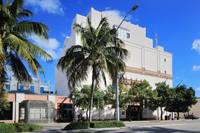
The Wolfsonian's exterior walls will become exhibition spaces for the display of digital images, thanks to a three-year, $500,000 grant from the John S. and James L. Knight Foundation. The Wolfsonian is one of only twenty cultural institutions in Miami-Dade and Broward counties (from a pool of 1,562 applicants) to be awarded a 2009 Knight Arts Challenge grant, a community-wide contest that seeks out the best ideas for the arts in South Florida.

The Wolfsonian's initiative, The Art of Illumination: Illuminating the Arts, will utilize lighting systems and digital technology to display images ranging from large-scale reproductions of pieces in the museum's collection to commissioned contemporary works. The exterior displays will be presented in a variety of formats including images, video, film, static and moving text, and interactive mobile technology. The Wolfsonian began this project in 2005, working with New York-based Herves Descottes and L'Observatoire Internationale to develop the concept, but lacked funding to realize it until now.

The Art of Illumination will bring the collection located within the museum's walls outside, introducing the materials to a large audience of passersby, which will extend the museum's reach. The project is partly a response to the physical design of the museum's building, originally built as a storage facility and deliberately designed to be inaccessible to the public. Now, as a public institution, the museum aims to reach the widest audience possible. The large variety of materials displayed through the "Art of Illumination" will allow the museum to address a mass audience to communicate the pivotal role that art, design, and culture play in shaping and reflecting human experience.

"At night, it will look like the building wakes up and turns into a dream, something magical," says Wolfsonian director Cathy Leff. "Miami Beach is a city to be experienced at night, and these projected images will give an identity to the building, allow interactive activities, break open the vault, and bring the collection and exhibitions outside for all to see and entice them to come into the museum."

The large-scale digital images seen in the center of South Beach's historical district will have other ramifications as well. "The Wolfsonian's innovative project will not only elevate the museum's status as a civic landmark, but also enhance Miami Beach's international reputation as a center for art and design," says Dennis Scholl, Miami program director for the Knight Foundation.

Calendar

Support Your Local Galleries and Museums! They Are Economic Engines for Your Community.

Subscribe to Our Free Weekly Email Newsletter!

Copyright 2012 Art Museum Touring.com