
| HOME | INDEX | EXHIBITIONS | ABOUT US | LINKS | CONTACT US | SUBSCRIBE |
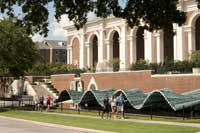 |
Meadows Museum
SMU Dallas Dallas, TX |
Museum photo by photo is by Hillsman Jackson
Meadows Museum SMU
5900 Bishop Blvd.
Southern Methodist University
Dallas, TX 75275-0357
Phone number: 214.768.2516
Fax: 214-768-1688
Map
www.meadowsmuseumdallas.org
Exhibitions
The Legacy of Vesuvius: Bourbon Discoveries on the Bay of Naples
Unearthing the Legacy of Islamic Spain
| SUPPORT OUR ADVERTISERS. THEY MAKE THIS SITE POSSIBLE |
| Premium Ad Space |
September 15, 2024–January 5, 2025
During the reigns of the Bourbon kings Charles III of Spain (who ruled as Charles VII of Naples from 1734 until 1759) and his son Ferdinand IV (1759 until 1799), the Mediterranean city of Naples established itself as a major European capital and key destination on the Grand Tour, even as Mount Vesuvius continued to smolder, threatening its environs. Throughout the latter half of the eighteenth century, these two monarchs funded archaeological excavations on the Bay of Naples that unearthed ancient treasures and fed into the craze for classical art that infused the Bourbon court.
The Legacy of Vesuvius: Bourbon Discoveries on the Bay of Naples will reveal the slippage between the ancient and modern during the reigns of these royal tastemakers. Through an eighteenth-century lens, Vesuvius’s volatility read as romantic; in its shadows the Bourbons financed excavations at the Roman sites of Pompeii and Herculaneum, the fruits of which both fueled and supplied demand for all things antique. Royal collections incorporated many of these artifacts, which were sometimes creatively manipulated to better suit eighteenth-century taste. New objects inspired by recently unearthed ancient art were also produced, contributing to the widespread popularity of neoclassicism. The Bay of Naples, itself a protagonist in this story, became a vital hub for artistic production, scientific exploration, and tourism during the eighteenth century.
The Legacy of Vesuvius offers a unique experience by bringing to Dallas ancient artifacts discovered in the course of the Bourbon excavations and exhibiting them alongside eighteenth-century examples of fine and decorative arts that demonstrate how the mystique of Vesuvius shaped elite and popular taste. Featuring loans from the Museo e Real Bosco di Capodimonte, Museo Archeologico Nazionale di Napoli, The Metropolitan Museum of Art, and the Wellcome Collection, audiences will gain new insights into the role of the Bourbon court in shaping European art and culture.
Complementing the exhibition will be a special installation—on view beginning September 26—in the downstairs galleries of paintings and drawings from the Meadows’s permanent collection by Spanish artists working in Italy. For centuries, Spanish artists have found cities like Rome, Venice, Naples, and their surroundings, to be a significant source of creativity and a crucial destination for artistic development. Drawn by the allure of Italy’s history, artists have embarked on artistic pilgrimages to study classical works and immerse themselves in the country’s vibrant cultural milieu. Highlights of the installation include rarely seen works on paper such as drawings from The Stewart Album, a series of watercolors by Pedro Cano, and the museum’s latest acquisition: Inventario (2023), by Ignasi Aballí.
This exhibition has been organized by the Meadows Museum, SMU, Dallas, and the Edith O’Donnell Institute of Art History at the University of Texas at Dallas, and is funded by a generous gift from The Meadows Foundation, with additional support provided by the Edith O’Donnell Institute of Art History. Promotional support provided by the Dallas Tourism Public Improvement District and the Consulate General of Italy in Houston.
September 15, 2024¬–January 5, 2025
In The Alhambra: Tales and Sketches of the Moors and Spaniards, the American writer and diplomat Washington Irving (1783–1859) conjured tantalizing images of the famous Islamic palace-fortress in Granada, renowned for its magnificent architecture and intricate ornament. The fictionalized scenes that Irving exported solidified ideas about Spain in the popular imagination, generating Orientalist fantasies of the “Moorish” past that had a lasting impact within Spain and abroad. The persistent question, how Islamic is Spain?, was asked by politicians, historians, travelers, and artists, and answered in diverse, often contradictory ways.
In a companion exhibition to the archaeologically focused The Legacy of Vesuvius: Bourbon Discoveries on the Bay of Naples (also September 15, 2024–January 5, 2025), Unearthing the Legacy of Islamic Spain explores how the Islamic monuments of the Iberian Peninsula—also being excavated after centuries of neglect—became powerful symbols of Spanish culture and identity. Drawing on the Meadows Museum’s permanent collection, SMU’s Bridwell and DeGolyer Libraries, and two local private collections, Unearthing the Legacy of Islamic Spain illuminates a moment of intense social and cultural change in Spain, when debates raged about national identity and modernization, which in turn yielded a cultural resurgence and renewed interest in Spain’s past, including its Islamic heritage.
Paintings, drawings, and printed material from the nineteenth century reflect diverse perspectives on Spain’s long history of Muslim rule, from the arrival of the Umayyads in the eighth century until the expulsion of the last Nasrid sultan in 1492. Anchoring the exhibition is one of the medieval treasures of the Meadows Museum: an ornate marble capital of the tenth century from the palace-city of Madinat al-Zahra?, near Córdoba. This architectural fragment embodies the medieval material that the nineteenth-century works responded to and together, these objects and images will highlight the tension between Spain’s medieval past and its modern interpretations.
This exhibition has been organized by the Meadows Museum and is funded by a generous gift from The Meadows Foundation. Promotional support provided by the Dallas Tourism Public Improvement District.
May 5–September 22, 2024
This focused, monographic exhibition of key paintings by Dallas-based artist Barnaby Fitzgerald (b. 1953) from prominent local collections will honor the artist’s prolific career and celebrate his election to professor of art emeritus at SMU.
Over a career spanning five decades and three continents, Fitzgerald has built a reputation for his otherworldly landscapes and interior scenes, which contemplate themes from literature, mythology, and art history. Drawing on the tradition of Surrealism, he offers imaginative reinterpretations of classical allegories in his own unique, contemporary language. These compositions are populated by a captivating cast of characters, such as grisaille sculptural studies, skeletons, and individuals from his own life.
Fitzgerald is also known for his mastery of the egg tempera technique, a medium he was initially drawn to for its luminosity and its association with late medieval paintings. A beloved professor of art at SMU since 1984, Fitzgerald was bestowed with the title of professor emeritus of art upon his retirement in 2023. Fitzgerald is represented in Dallas by Valley House Gallery.
His work is held in multiple public collections across the US, including the Meadows Museum, the Museum of Fine Arts, Houston, and the Yale University Art Gallery, as well as many private collections around the world. Located in the museum’s first-floor galleries, this installation will feature a selection of the artist’s oil and egg tempera paintings, surveying his work over the last three decades.
Barnaby Fitzgerald: An Eye for Ballast is organized by the Meadows Museum with the support of the Office of the Dean of the Meadows School of the Arts.
|
|
||
Subscribe to Our Free Weekly Email Newsletter!