HOME INDEX EXHIBITIONS EVENTS ABOUT US BLOG LINKS CONTACT US SUBSCRIBE

The DeWitt Wallace Decorative Arts
Museum

Williamsburg, VA

1-800-752-1952
Hunt-Wulkowicz Graphics
Fire Engine
Exhibition: Richard Newsham’s Fire Engine
Fire Engine
Exhibition: Dollars, Farthings & Fables: Money and Medals from the Colonial Williamsburg Collection
North Carolina Currency Hoard of Samuel Cornell 1748-1771, America, North Carolina
Various Paper, ink, paste, pins, & thread
Anonymous gift
North Carolina Currency Hoard of Samuel Cornell, 1748-1771
A French map describing the military and naval forces during the 1781 Siege of Yorktown.
Exhibition: More Than Meets The Eye
A French map describing the military and naval forces during the 1781 Siege of Yorktown.
Exhibition: Fashion Accessories from Head to Toe
Two-handled covered cup, 1649-1650
Exhibition: Treasure Quest: Great Silver Collections from Colonial Williamsburg
Maker: "Hound Sejant" maker
Origin: England, London
Two-handled covered cup, 1649-1650
OH: 8"; OW: 7 3/4"; H(rim): 4 7/8"; Diam (cover): 5 3/16"; Diam (rim): 4 1/2"; Diam (base): 3 7/8"
Silver (Sterling); Gold (Silver-gilt)
Acc. No. 1938-32,A&B
Exhibition: "A True North Britain": The Furniture of John Shearer, 1790-1820
John Shearer
Chest
Exhibition: "A True North Britain": The Furniture of John Shearer, 1790-1820

The DeWitt Wallace Decorative Arts Museum
The Art Museums of Colonial Williamsburg
326 W. Francis St.
Williamsburg, Va. 23185
(757) 220-7724
Map


www.history.org/museums

Hours
The museums are open daily and hours of operation vary seasonally.

Admission
Admission to the Art Museums of Colonial Williamsburg is included in the following Colonial Williamsburg general admission passes: One-Day Pass, Two-Day Pass, Annual Pass, CW Hotel Guest Pass, and also the local resident Good Neighbor Pass.

The following ticket options are also available for access to the museums only:

  • One-Day Museum Ticket
    • Adult: $10.00
    • Youth (6-17): $5.00

  • Annual Pass
    • Adult: $20.00
    • Youth (6-17): $10.00

About the DeWitt Wallace Decorative Arts Museum
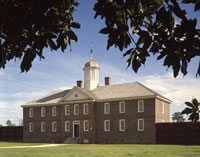
The award-winning DeWitt Wallace Decorative Arts Museum houses the Foundation’s renowned collection of British and American fine and decorative arts dating from 1600 through 1830. Featured in regularly changing exhibitions, these include the world’s largest collection of Southern furniture; nationally important holdings in English silver and pewter; a vast collection of 18th-century clothing and textiles; and one of the largest collections of British ceramics outside England. Masterworks and period pieces acquired for Colonial Williamsburg’s Historic Area exhibition buildings bolster the museum’s holdings in furniture, metals, ceramics, glass, paintings, prints, maps, tools, weapons, numismatics and textiles.

The DeWitt Wallace Decorative Arts Museum, opened in 1985 and features 15 galleries in 25,000 square feet of exhibition space as well as an auditorium and a café.

The Art Museums of Colonial Williamsburg also include the Public Hospital, a reconstruction of the first facility in 18th-century North America dedicated solely to the treatment of the mentally ill. Besides serving as an entry to the art museums, the Public Hospital contains several exhibits detailing mental illness treatments from the 18th and 19th centuries.


Featured Exhibits

Richard Newsham’s Fire Engine

"A True North Britain": The Furniture of John Shearer, 1790-1820

More Than Meets The Eye

Fashion Accessories from Head to Toe

Dollars, Farthings & Fables: Money and Medals from the Colonial Williamsburg Collection

Rebuilding Charlton's Coffeehouse

Conservation: Where Art and Science Meet

Treasure Quest: Great Silver Collections from Colonial Williamsburg

Identifying Ceramics: The Who, What and Ware

Musical Instruments

Selections from the Henry H. Weldon Collection

Lock, Stock, and Barrel

Artistry and Ingenuity

Revolution in Taste

Masterworks


Richard Newsham’s Fire Engine
Feb. 8 then ongoing

The fire engine was originally constructed by Newsham & Ragg of London between 1744 and 1765 under the specifications of Richard Newsham’s patents of 1721 and 1725. His design was the first to discharge water in a very powerful continuous stream. A Newsham broadside, printed in 1727, claims that the engine could hold 125 gallons of water, discharge at the rate of 125 gallons per minute and spray effectively at a distance of 45 yards.

“Richard Newsham’s fire engines became the clear choice for anyone in England or America who was serious about combating fires,” said Erik Goldstein, Colonial Williamsburg’s curator of mechanical arts and numismatics. “So effective were Newsham’s engines that some were used for more than a century. Many survive today in museum collections on both sides of the Atlantic as a testament to their popularity, quality and usefulness.”

Based on the size of its water cistern, or reservoir, this engine appears to be the fourth largest of six available sizes. Its estimated weight is 700 pounds empty and 2,000 pounds fully loaded and equipped. It is constructed of wood, iron, various copper alloys, leather, oil and paint.

The fire engine was refurbished and updated around 1830 by Hadley, Simpkin & Lott, also of London, probably in conjunction with the engine’s sale at that time. The company’s cast plaque remains on the engine and is thought to have been placed over a painted signature of Newsham & Ragg.

Sir Thomas Crawley-Boevey purchased the refurbished used fire engine in 1830 for slightly more than £53 to be used on his estate at Flaxley Abbey in Gloucestershire. It was used there until well into the 20th century. Colonial Williamsburg purchased it in 1960 from a British dealer.

In addition to the fire engine itself, the related equipment includes buckets, a coil of hose and other ancillary equipment.

“Richard Newsham’s Fire Engine” will be on view through 2013. A Colonial Williamsburg admission ticket or Museum ticket is required. The DeWitt Wallace Decorative Arts Museum is located at 324 West Francis St. and is open daily throughout the year.

Colonial Williamsburg’s Historic Trades artisans reproduced the fire engine in the early 1980s. The reproduction fire engine can be seen in the shed at the Guard House next to the Magazine in the Historic Area.


"A True North Britain": The Furniture of John Shearer, 1790-1820
April 2, 2011 through March 2012.

This ground-breaking traveling exhibition organized by the Daughters of the American Revolution Museum in Washington, DC., examines the furniture of John Shearer, a joiner who worked in the backcountry of Virginia and Maryland from ca. 1790-1820. Through the use of inlay and inscriptions, Shearer's furniture demonstrated his loyalty to Great Britain. Shearer's continued allegiance to Great Britain and her Royal Navy after the American Revolution underscored the evolving political landscape of the new United States.


More Than Meets The Eye
March 26 through April 2012

This exhibition explores how maps and prints aided colonial expansionists by conveying attitudes and values that swayed public opinion. Portraits depicted Native Americans as deferential subjects of the king. Maps, regarded as scientific and authoritative documents, were designed to impart a perception of power and control over the environment, claim land, and establish boundaries. The exhibition features maps and prints from the Foundation's nationally important collection, as well as important pieces borrowed from other institutions and private collectors. A few of the maps and prints have rarely been on view, including the so called "Frenchman's Map" from the collections of Swem Library at the College of William and Mary, which illustrates the 18th-century town of Williamsburg. This exhibition is made possible by the Nicholas and Eleanor Chabraja Foundation.


Fashion Accessories from Head to Toe
Through December 31, 2012

This exhibition features costume accessories from the late seventeenth through the early nineteenth century. Women and men enhanced their appearance with the addition of hats, purses, jewelry, shoes, and more. These objects kept pace with change in fashion and present a visually rich overview of the period. The exhibition is made possible by Mary and Clinton Gilliland of Menlo Park, California, and the Turner-Gilliland Family Fund of the Sillicon Valley Community Foundation.


Dollars, Farthings & Fables: Money and Medals from the Colonial Williamsburg Collection
November 25, 2010 -

This exhibition showcases some wonderful treasures from the numismatics collection. See the smallest and largest coins in the collection as well as the prettiest and ugliest. Find out about the first dollar bill, the medals that were produced to honor George Washington, and the first coins made in the New World. One of our newest acquisitions is an amazing collection of paper money that was amassed in the late 18th-century by Samuel Cornell of North Carolina. Like other pieces in the exhibition, it has an interesting story to tell.


Rebuilding Charlton's Coffeehouse

Colonial Williamsburg’s recent reconstruction of Charlton’s Coffeehouse is the first ground-up reconstruction along Duke of Gloucester Street in several decades. It involved the work of every department and trade in the Foundation. The exhibition explores how such a building could be so accurately constructed and furnished when seemingly very little was left of the original structure. It will use archaeological, architectural, archival, decorative arts and trades components to show visitors the process of rebuilding the history, structure, and interiors of the coffeehouse. Through video, graphics, original objects, and touchable reproductions, visitors will learn firsthand what it took to bring the project to completion.


Conservation: Where Art and Science Meet
Through May 31, 2012.

This exhibition presents a different way of looking at museum objects. Visitors will discover what is harmful to objects and what preserves them. Before an object is shown, conservators investigate each piece with a variety of fascinating techniques to understand the object and ensure its preservation for the future. This exhibition was made possible in part by: The Stone Family Fund, Los Angeles, Calif., and The Friends of Heritage Preservation, Los Angeles, Calif.


Treasure Quest: Great Silver Collections from Colonial Williamsburg
Ongoing exhibit

This exhibition in the Mary Jewett Gaiser Gallery displays selections from the Foundation’s vast collection of 18th-century British silver. The collection has grown through generous gifts from collectors of everything from lavish silver-plated dining wares to striking Scottish tea wares. .


Identifying Ceramics: The Who, What and Ware
Ongoing exhibit

This exhibition takes a closer look at the production and decoration of ceramic wares of the eighteenth century. Find out the difference between stoneware, earthenware and porcelain and discover how ornament was created or applied.

Musical Instruments
Ongoing exhibit

An exhibition of two types of keyboard musical instruments. The 1762 harpsichord made by Jacob Kirckman of London makes its sound by plucking the strings. An 1806 grand piano by John Broadwood and Sons, also of London, sounds by means of hammers that strike the strings. These makers were the most celebrated in England and America when these two superlative instruments were made. Both instruments are in good playing order and are used for programs in the Hennage Auditorium.


Selections from the Henry H. Weldon Collection
Ongoing exhibit

This exhibition in the Henry H. Weldon Gallery features a few select pieces from the collection of more than 725 pieces of 18th-century British pottery donated to Colonial Williamsburg by Mr. and Mrs. Henry H. Weldon.


Lock, Stock, and Barrel
Ongoing exhibit

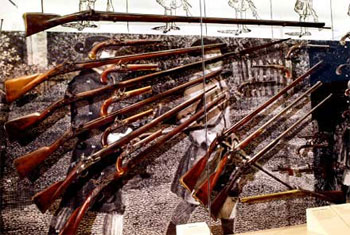
This exhibition is an outstanding display of military and civilian weapons exploring muzzle-loading firearms, ignition systems, and the evolution of the standing British infantry musket before 1800.


Artistry and Ingenuity
Ongoing exhibit

This exhibition looks at colonial kitchen equipment from an aesthetic and practical viewpoint, highlighting its beauty and utility.


Revolution in Taste
Ongoing exhibit

This exhibition dazzles with rich and colorful choices in table and tea wares available to 18th-century British and American consumers. Expanding world trade and strengthening industry put a teapot on every table -- until tea became a symbol of protest in the American Revolution.


Masterworks
Ongoing exhibit

This exhibition features splendid examples of British and American antiques from 1660 to 1820, including a sterling silver chandelier made for King William III and Charles Willson Peale's portrait of George Washington as commander of the American forces during the Revolution.


Calendar

Support Your Local Galleries and Museums! They Are Economic Engines for Your Community.

Subscribe to Our Free Weekly Email Newsletter!

Advertise with this banner
BACK NEXT
Copyright 2012 Art Museum Touring.com