Map
e-mail: info@georgeohr.org
www.georgeohr.org
Coronavirus -19 Reopening Information:
Visitiing, Safety Procedures, Hours, Admission
|
MUSEUM HOURS
Gallery Hours
386 Beach Boulevard
Tuesday – Saturday, 10:00 a.m. – 5:00 p.m.
Business Hours
Monday - Friday:
9:00 a.m. - 5:00 p.m.
Admission
Adult - $10
Senior - Over 60 - $8
Student - Ages 6-17 - $5
Child - Under 6 - Free
About the Ohr-O’Keefe Museum of Art
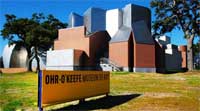
The Ohr-O’Keefe Museum of Art, located on a four acre campus in Biloxi, Mississippi, was designed by Frank O. Gehry, Gehry Partners LLP, Los Angeles, California. Set within a grove of ancient Live Oak trees, Frank Gehry designed the Ohr-O’Keefe project as a series of six small pavilions woven among the trees and connected by an open brick plaza, creating an inviting and lively arts campus that maintains the existing park setting and encourages pedestrian circulation throughout the site. The entire project employs a micro-pile foundation system intended to minimize impact on the root systems of the Live Oak trees. The use of local materials, the use of references to the local vernacular, and the scale and placement of each of the pavilions on the site, represent sensitive responses to the conditions of the site and to the context of the surrounding area. The 25,000 square foot Ohr-O’Keefe Museum campus provides facilities for art exhibition and education, and cultural and community events.
The design process took four years: 1999-2003. In 2004, construction began. August 29, 2005 Hurricane Katrina heavily damaged or destroyed the buildings which were 18 months from completion.
Rebuilding began in 2008 and NOW FOUR of the five Gehry designed buildings and two historical structures ARE OPEN to the public including:
Mississippi Sound Welcome Center
IP Casino Resort Spa Exhibitions Gallery
Gallery of African American Art
City of Biloxi Center for Ceramics
Pleasant Reed Interpretive Center
CREEL HOUSE STUDIO
The final phase will include the John S. and James L. Knight Gallery (the “Pods”) housing George Ohr exhibitions will open soon..
Ohr-O'Keefe Museum of Art Mission
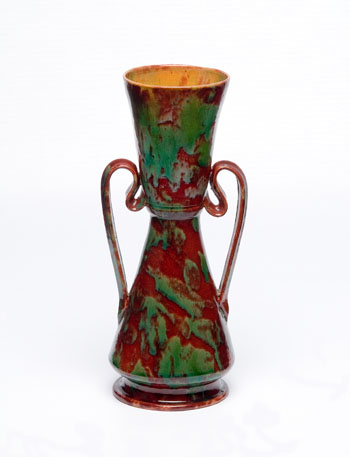
The Ohr-O’Keefe Museum of Art mission is to promote and preserve the unique legacy of Biloxi potter George E. Ohr and the diverse cultural heritage of the Mississippi Gulf Coast; and to exhibit works which exemplify the independent, innovative, and creative spirit of George Ohr, emancipated craftsman Pleasant Reed, and Ohr-O’Keefe Museum architect Frank Gehry. This mission is served through compelling exhibitions and educational experiences viewed from a fresh perspective relevant to our community, the region, and the nation with a strong focus on ceramic arts. -Board of Trustees 1/13/2010
The Pleasant Reed Interpretive Center
The Pleasant Reed Interpretive Center is a reconstruction of the original house built by Pleasant Reed during the 1880s and 1890s. The Gulf Coast Alumnae Chapter of the Delta Sigma Theta Sorority, Inc. had the foresight and the commitment to save the house from demolition by purchasing it in 1978. In 2000 the Reed house was donated to the Ohr-O’Keefe Museum of Art by Delta Sigma Theta. The house was moved from Elmer Street to the site of the Ohr-O’Keefe Museum of Art in 2002 to insure that this cultural and educational resource would be used to tell the story of a modest but remarkable family that became a significant part of Biloxi’s history. The completely renovated Pleasant Reed House opened to the public at the groundbreaking ceremony for new the Ohr-O’Keefe Museum of Art in May 2003.
On August 29, 2005, the House and the original furnishings contained in the house were destroyed by Hurricane Katrina. The Board of Trustees of the Ohr-O'Keefe Museum of Art was determined to continue honoring the legacy of Pleasant Reed and his family. In 2006 the board voted to replicate the Pleasant Reed House as the Pleasant Reed Interpretive Center so that the generations to follow could continue to learn about this remarkable man. Working from Reed’s original plans the house was reconstructed on the site of the Ohr-O’Keefe Museum of Art. The interior of the house was changed to accommodate tours and exhibitions while the exterior is an exact model of the house Pleasant Reed built.
A visit to Pleasant Reed Interpretive Center provides a rare opportunity to see how an African-American family with limited means lived in Biloxi during the early twentieth century. Like the Acadian French, Slavonian, and Italian immigrants of that time, and the Hispanic and Vietnamese immigrants of more recent times, the Reed family came to Biloxi to seek a better life for themselves and their children. While every immigrant ethnic group faced difficulties in finding acceptance within their adopted community, the Reeds had additional challenges because of the increasingly rigid segregationist laws that characterized the "Jim Crow" era in America. The story of their lives is one of perseverance and determination in spite of dauntingly adverse circumstances.
Exhibitions:
Cathy Hegman
March 17 – June 6, 2020
(more information)
Dean Mitchell
March 10 – May 30, 2020
(more information)
From the Kingdom: Charles Smith
TBD
(more information)
George Edgar Ohr: Selections from Gulf Coast Collections
Ongoing
(more information)
My House: The Pleasant Reed Story
Pleasant Reed Interpretive Center
Ongoing
(more information)
The Native Guard: A Photographic History of Ship Island’s African American Regiment
Pleasant Reed Interpretive Center Gallery
Ongoing
(more information)
Events