HOME INDEX EXHIBITIONS EVENTS ABOUT US BLOG LINKS CONTACT US SUBSCRIBE

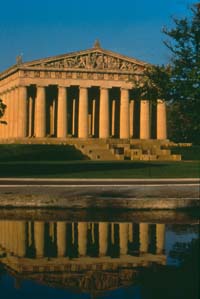
The Parthenon
The Parthenon

Nashville, TN

SUPPORT OUR ADVERTISERS. THEY MAKE THIS SITE POSSIBLE
Premium Ad Space
Western façade of the Parthenon, 1869. From The Acropolis of Athens (1870), Plate 9.
Exhibition: WISH YOU WERE HERE: CULTURAL TOURISM AND THE PARTHENON
William James Stillman
Western façade of the Parthenon, 1869. From The Acropolis of Athens (1870), Plate 9.
Carbon print
Collection of the Parthenon, 00.1.2
Exhibition: PURLIEU: SHARON CHARNEY & ANNE WILLIAMS
Anne Williams
SYCAMORE LEAF
silver leaf & oil on hardboard, 16 x 16”
SYCAMORE LEAF
MAPLE LEAF
Exhibition: ORIGINS OF NASHVILLE’S PARTHENON
Byron Jorjorian
Dodge Marathon Car poster
luggage tag
Centennial Collection, L2011.1.63.
Exhibition: ORIGINS OF NASHVILLE’S PARTHENON
Byron Jorjorian
Dodge Marathon Car poster
luggage tag
Centennial Collection, L2011.1.63.
Mountains in orange-hued mist in the Powell Valley in the Cumberland Mountains

The Parthenon
25th at West End Ave,
Centennial Park,
Nashville, TN 37201
(615) 862-8431
Map


Visit the Parthenon website: www.parthenon.org

HOURS OF OPERATION
The Parthenon is open year round Tuesday - Saturday, 9:00 - 4:30.
Admission: $6.00 for Adults and $3.50 for Seniors (age 62 and over) and Students (ages 4-17), Children under 4 are free. Prices and hours subject to change without notice.
Closed New Year's, Thanksgiving, and Christmas

The Parthenon stands proudly as the centerpiece of Centennial Park, Nashville's premier urban park. The re-creation of the 42-foot statue Athena is the focus of the Parthenon just as it was in ancient Greece. The building and the Athena statue are both full-scale replicas of the Athenian originals.

Originally built for Tennessee's 1897 Centennial Exposition, this replica of the original Parthenon in Athens serves as a monument to what is considered the pinnacle of classical architecture. The plaster replicas of the Parthenon Marbles found in the Naos are direct casts of the original sculptures which adorned the pediments of the Athenian Parthenon, dating back to 438 B.C. The originals of these powerful fragments are housed in the British Museum in London.

The Parthenon also serves as the city of Nashville's art museum. The focus of the Parthenon's permanent collection is a group of 63 paintings by 19th and 20th century American artists donated by James M. Cowan. Additional gallery spaces provide a venue for a variety of temporary shows and exhibits.

  • The Metro Board of Parks and Recreation does not discriminate on the basis of age, race, sex, color, national origin, or disability in admission, access to, or operations of its programs, services, or activities. For TTY (relay service), call 1-800-849-0299. For questions, concerns, or requests regarding the American Disabilities Act call 862-8400.


Exhibitions:

WISH YOU WERE HERE: CULTURAL TOURISM AND THE PARTHENON
January 28-May 19, 2012

PURLIEU: SHARON CHARNEY & ANNE WILLIAMS
November 12, 2011 –April 28, 2012
West Gallery

ORIGINS OF NASHVILLE’S PARTHENON
New permanent exhibition exploring the history of Nashville’s beloved landmark
Ongoing


The Parthenon’s Saturday Series 2012

Ancient Greek Philosophers: The Foundation of Western Intellectual History

To help chase away the blahs of mid-winter the Parthenon resumes its well-regarded Saturday Series, scheduled for Saturday mornings in February from 10:30 – noon. This year’s classes cover the philosophers whose work provides the underpinning for the past two millennia of western philosophical thought.

The four Saturdays are devoted to Presocratic Philosophers (2/4), Plato (2/11), Aristotle (2/18) and Hellenistic Philosophers (2/25) and will be taught by three faculty members from Belmont University’s Philosophy Department. The Presocratics were the earliest Greek philosophers, appearing after Homer and before Socrates. Their work laid the foundation for western philosophy, science and theology. Plato founded a school and research institution known as The Academy and wrote over thirty influential dialogues. The history of western thought since then has been referred to as “a series of footnotes to Plato.”

Plato’s most famous student, Aristotle, founded his own school, The Lyceum, and wrote about everything from Physics and Metaphysics to Politics, Poetry and Zoology. The Hellenistic era (323 BCE – 146 BCE) produced Epicureanism, Stoicism and Neoplatonism.

The series costs $60 ($50 to members of The Conservancy for the Parthenon and Centennial Park) and those interested in taking the classes may call the Parthenon (615-862-8431) or go to the Events page on the Parthenon’s website (www.parthenon.org) for more information about location and how to sign up.

Support Your Local Galleries and Museums! They Are Economic Engines for Your Community.

Subscribe to Our Free Weekly Email Newsletter!

Advertise with this banner
BACK NEXT
Copyright 2012 Art Museum Touring.com