 |
|
|||||||||||||||||||
|
|||||||||||||||||||
|
|||||||||||||||||||
|
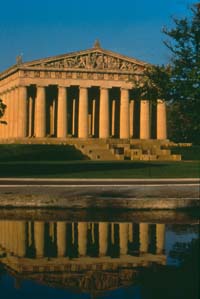
The Parthenon Visit the Parthenon website: www.parthenon.org |
|||||||||||||||||||
| Ethos: The Alchemy of Spirit and Light Through September 10, 2023 London Amara’s work in painting, drawing, sculpture, and photography is united by her interest in the human form and in our oft-conflicted relationship with the natural world. Over the past two decades, Amara has moved from biomorphic and gestural abstraction and, occasionally, handwritten text toward a more explicit focus on the body, both in its occupation of space and as a carrier of meaning. She has also become increasingly interested in depicting the American landscape, most often in its densest manifestations, but with an occasional nod to sparser environments. Throughout, she is concerned with skirting the expectation that photographs need always be directly representational, using it instead to record patterns of light and dark that refer primarily to themselves, or to nature as a quasi-spiritual force. Currently, Amara is pursuing large-format collodion wet plate photography, working on site in a portable darkroom to produce images of the forests of Florida, California, and British Columbia, and intimate portraits of family and friends. She produces silver gelatin and pigment prints characterized by the extremely fine detail and rich earth tones. She also incorporates technical flaws that contribute to the work’s handcrafted, painterly feel. Inspired in part by the work of contemporary photographers Sally Mann and Justine Kurland, she imparts her images with a melancholic romanticism born of nostalgic longing for her childhood in wooded rural Ohio, and offers her subjects as representatives of an ancient wisdom, possessors of a unique sensitivity to the endless cycle of life, death, and decay. ABOUT LONDON AMARA She was also a visiting lecturer at the University of South Florida. Following a car accident in 2009, Amara started moving away from the biomorphic and gestural abstraction, and occasional use of hand-written text, that characterize her earlier work, moving towards drawings, paintings, metal sculptures, and “body prints” that focus more explicitly on the human form and its physical and metaphorical occupation of space. Amara’s paintings, sculptures, and photographs have been shown in solo and group exhibitions at venues including the Columbus Conservatory in 1998, Sidney & Berne Davis Art Center, Fort Myers, Florida (2009, 2013 and 2018), and Tampa Museum of Art (2016). She has also undertaken a number of private and public commissions for clients including the Tampa Bay Lightning hockey team, producing an installation that is now on permanent display at the Tampa Bay Forum box office—and was the recipient of the 2013 Vincent LeCavalier Commemorative Commission. Amara’s work is represented in the permanent collections of institutions and businesses including Allstate Insurance, Diamond District, Fine Mark Bank, Florida Gulf Coast University and has been discussed in Art SWFL, Arts Tampa Bay, duPont REGISTRY, Florida Weekly, Grandeur, Gulf Coast Times, Fort Myers Magazine, Fort Myers News-Press, and Spotlight. It is also the subject of a 2012 film from Brandon Hyde’s Rising Sky Studios (now Digital Caviar). Currently, she is pursuing large-format collodion wet plate photography, producing intimate black-and-white portraits and haunting images of the wooded landscapes of Ohio, Florida, California, and British Columbia. |
|||||||||||||||||||
| Back to Page 1 |
|
||||||||||||||||||
| Support Your Local Galleries and Museums! They Are Economic Engines for Your Community.
Subscribe to Our Free Weekly Email Newsletter! |
|||||||||||||||||||
| ADVERTISE ON THIS SITE | HOME | EXHIBITIONS | INDEX | ABOUT US | LINKS | CONTACT US | DONATE | SUBSCRIBE |
| Copyright 2023 Art Museum Touring.com |